
If you’ve spent any time on LinkedIn in the past year, you’ve seen the term “AI SDR” everywhere. Vendors promise it will replace your outbound team. Others use it interchangeably with “AI agent,” “automation,” or “sales AI”, as if they’re all the same thing.
They’re not. And the difference matters, because it changes what you should actually expect to pay for, and what you shouldn’t.
This post cuts through the marketing language. No product to sell you here, just a clear breakdown of what an AI SDR actually is, how it’s different from the outbound automation tools you probably already use, and where the category genuinely delivers versus where it’s still overhyped.
What “AI SDR” Actually Means
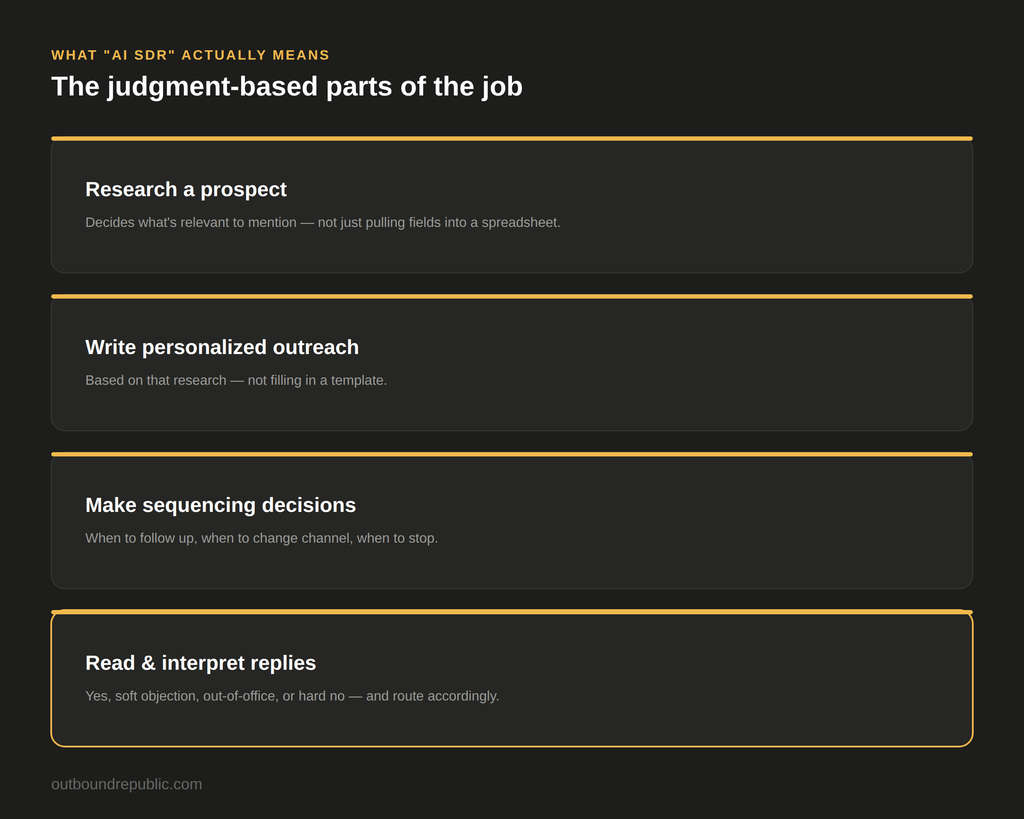
Strip away the branding, and an AI SDR is software designed to handle the judgment-based parts of an SDR’s job, not just the repetitive execution.
That means:
- Researching a prospect and deciding what’s actually relevant to mention, not just pulling fields into a spreadsheet
- Writing personalized outreach based on that research, rather than filling in a template
- Making sequencing decisions – when to follow up, when to change channel, when to stop
- Reading and interpreting replies – is this a “yes,” a soft objection, an out-of-office, or a hard no – and routing accordingly
The core claim vendors make is that the software isn’t just executing a fixed workflow. It’s making per-prospect decisions the way a human SDR would, and it’s exactly this line – structured, rule-based tasks versus the nuanced judgment calls that still need a person – that separates a genuine AI SDR from a glorified mail-merge tool.
That’s the promise. The reality, as of today, is uneven. Most AI SDR tools are genuinely strong at research and first-draft personalization. Far fewer are reliable at the judgment calls that come later in the funnel — qualifying an ambiguous reply, for instance, is still a place where these tools frequently get it wrong.
What It’s Not: The Automation You Already Know
If you’re running outbound today, you’re almost certainly already using tools that get lumped into “AI SDR” conversations but aren’t actually doing the same job:
| Task | Rule-based automation | AI SDR |
|---|---|---|
| Find a decision-maker’s email | ✅ Enrichment tools (Clay, Apollo, ZoomInfo) | Same – no real difference here |
| Send follow-up #3 if no reply after 4 days | ✅ Sequencing tools (Smartlead, Instantly, Outreach) | Same, but can also decide to skip or change channel |
| Insert first name and company into a template | ✅ Basic mail merge | Writes a genuinely custom opener, referencing context like a funding round or job posting |
| Decide whether a reply is a “yes” and route it to a rep | ❌ Not possible – needs a human | This is the actual differentiator |
The pattern is simple: enrichment and sequencing tools are excellent at moving data around on a schedule. They don’t interpret anything. An AI SDR is meant to sit on top of that layer and make contextual calls — which is a fundamentally different (and harder) problem.
Where the Line Actually Blurs
Here’s the part most “what is an AI SDR” explainers skip: the underlying capabilities aren’t exclusive to a single product category. They’re a set of AI agent functions, and they can live inside a point-solution tool, a fully autonomous platform, or a managed outbound program.
We’ve written about two of these functions already, because we use them ourselves:
- In Quality Assurance in AI-Powered Outbound: Why You Need a Reviewer Agent, we broke down how an AI reviewer agent checks outbound copy before it sends – which is exactly the kind of judgment layer that AI SDR vendors market as their key differentiator.
- Our piece on how AI agents are replacing manual campaign setup covers how research and targeting decisions — the front half of what an “AI SDR” does – can be automated inside an existing campaign workflow, not just inside a standalone AI SDR product.
The point isn’t that “AI SDR” is a meaningless term. It’s that it describes a set of capabilities, not a category you have to buy as a single packaged tool. Those capabilities can be, and increasingly are, built into how a managed outbound program runs, with a human reviewing the output.
AI SDR vs. AI BDR vs. “AI Agent” — Quick Disambiguation
Since people search these terms interchangeably, a fast clarification:
- AI BDR is functionally the same idea as AI SDR – the split between SDR (inbound-leaning) and BDR (outbound-leaning) titles has mostly faded, and vendors use both terms for the same product type.
- AI agent is the broader, underlying technology – a system that can take actions and make decisions based on context. An “AI SDR” is one specific application of AI agents, purpose-built for outbound prospecting. Not every AI agent is an AI SDR, but every AI SDR is built on AI agent technology.
What AI SDRs Are Genuinely Good At Right Now
To be fair to the category, because it’s not all hype, here’s where it holds up:
- Research and enrichment at scale. Pulling and synthesizing signals across dozens of prospects per hour is a real, proven strength – the kind of manual research grind that used to eat hours of an SDR’s day now happens in seconds.
- First-draft personalization. Getting from a blank page to a solid, context-aware opener, fast.
- Freeing up human time. Whether that’s your in-house SDR or your agency’s account team, less time spent on manual research means more time on strategy, reply handling, and the conversations that actually move deals forward.
- Consistency. No bad days, no missed follow-ups, no copy-paste mistakes at 4pm on a Friday.
Where AI SDRs Still Fall Short
- Ambiguous replies. “Interested, but check back in Q3” or a soft objection buried in a longer message — this is still where AI tools misfire most often, and it’s exactly the kind of read that good qualification depends on gentle, conversational judgment rather than a checklist.
- Complex, multi-stakeholder sales. If you’re selling into a buying committee with a long, relationship-driven cycle, fully autonomous outreach tends to feel exactly like what it is — automated. We’ve written more about why that’s especially true in niche B2B markets and long sales cycle industries, where generic playbooks, AI-powered or not, tend to break down.
- Full autonomy without review. Letting an AI SDR run completely unsupervised is a quality and deliverability risk. The teams getting the best results treat AI output as a strong first draft, not a finished product.
How to Think About Buying (or Not Buying) One
A simple way to frame the decision:
- If your ICP is well-understood, your offer is straightforward, and you need volume with consistency, a point-solution AI SDR tool can genuinely work well on its own.
- If your buying process is complex, involves multiple stakeholders, or depends on trust built over several touches — AI agents work best as a layer inside a managed program with human oversight, not as a replacement for one.
That’s also how we use AI agents internally: as a research, drafting, and QA layer inside campaigns a human still owns end to end.
The Three Questions to Ask Any Vendor
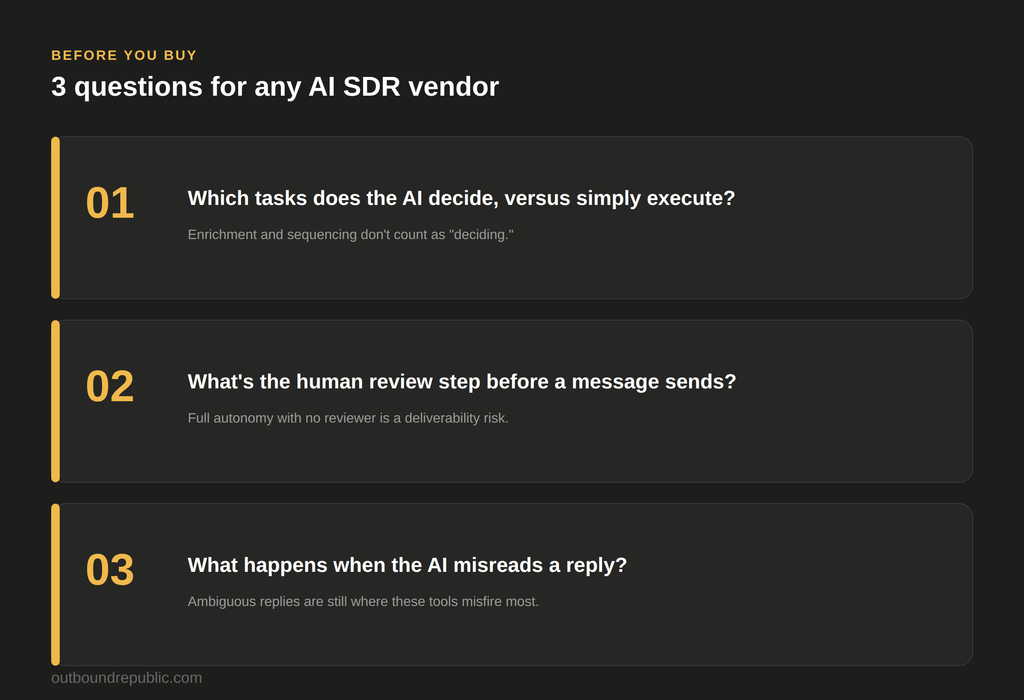
The term “AI SDR” will keep getting diluted as more vendors slap it on their landing page. What actually matters is which specific tasks are AI-assisted versus AI-decided, and how much human review sits on top. Before you buy, or before you trust an agency’s claim that they “use AI SDR technology, ask:
- Which specific tasks does the AI decide, versus simply execute?
- What’s the human review step before a message actually sends?
- What happens when the AI misreads a reply?
If you don’t get a clear, specific answer to all three, you’re not buying an AI SDR. You’re buying a mail-merge tool with better marketing. If you’d rather skip the vendor interrogation altogether, talk to us directly about where AI genuinely helps in your specific outbound motion.