
Setting up an outbound campaign used to be a serious time investment. A single client could require 20 or more hours per month just to handle the brief, define the target segments, build the list, write copy, and get sequences live. That work fell entirely on human shoulders, and it created a hard ceiling on how many clients a team could serve well.
That ceiling is now being pushed much higher by AI agents. Not AI-assisted tools where a human still does most of the thinking, but true agentic workflows that take a client brief and run with it from start to finish. If you’re weighing exactly how far this shift has gone, our overview of what AI agents can and can’t do yet in lead generation is a useful companion piece – it maps out the boundary between structured, automatable tasks and the nuanced work that still needs a person.
What a Manual Campaign Setup Actually Involved
Before understanding what AI agents replace, it helps to see what the old process looked like in detail.
When a new client came on board, the typical workflow went something like this:
- Client fills out a brief (usually a spreadsheet or intake form)
- A human strategist reads the brief, interprets the inputs, and draws out campaign ideas
- The strategist picks one or two market segments to prioritize, often based on instinct
- They define how to find companies in that segment, build search logic, and write qualification criteria
- Copy is written for each sequence step
- Everything gets loaded into the sending tool and tested before launch
That full process, done properly, consumed roughly 20 hours per client per month. For a small team running multiple accounts, this created constant pressure and made scaling extremely difficult. Our breakdown of where an SDR’s day actually goes in a manual workflow digs into this time cost in more detail, from research to admin work.
The human doing this work wasn’t just executing tasks. They were making judgment calls at every step: which segment looks most promising, how to frame the value proposition, which signals indicate a qualified lead. The complexity was the bottleneck.
How AI Agent Outbound Campaign Automation Works Now
Modern AI agent outbound campaign automation replaces most of that manual workflow with a structured, multi-step agent that runs the process end to end.
Here is how the automated version of the same workflow looks:
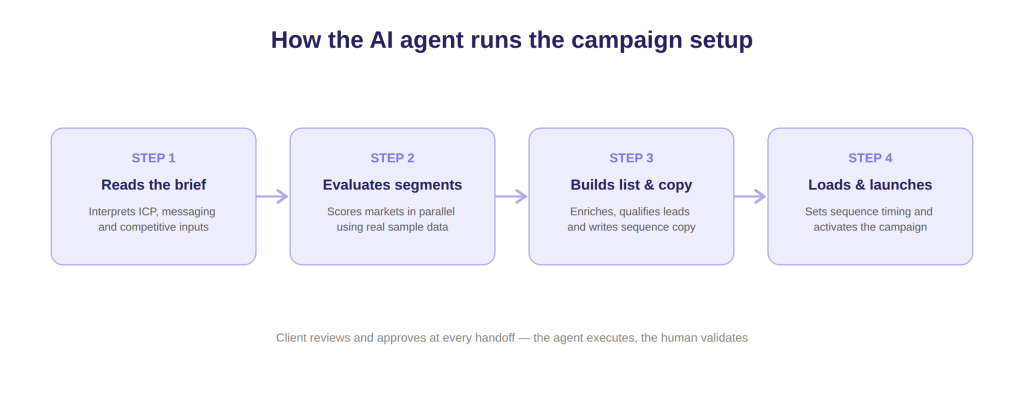
Reading and Interpreting the Brief
The client still fills out an intake document. But instead of a human spending hours extracting meaning from it, the brief goes directly into an AI agent built with specific frameworks for each section.
The agent has predefined ways of interpreting ICP information, messaging inputs, and competitive context. It works through each section systematically and produces a completed strategy brief, often within minutes. The output quality is consistently at or above what a human would produce manually.
The brief then goes back to the client for review. They approve it or send back notes, and a second pass refines it. The human role here is validation, not creation.
Parallel Segment Evaluation
One of the most significant upgrades in an automated lead generation workflow is how segment selection works.
Previously, a human would pick one segment to focus on, often based on their best guess. Now, the agent evaluates multiple segments simultaneously. For each one, it uses enrichment tools to map the addressable market, runs a small qualification sample to estimate how many companies in that segment actually fit the ICP, and then produces a ranked recommendation. This is close to what we cover in our guide to validating a new ICP in 30 days using outbound — the same principle of testing a segment with real data before committing to it, just compressed into an automated first pass. If you’re validating a brand-new market with little to no customer history yet, our piece on building an ICP with almost no customers covers that starting point directly. This kind of structured market scoring is also part of our GTM market validation service, for teams that want it run end to end.
This means decisions get made based on real data, not intuition. And it happens in parallel, so the time cost does not scale with the number of segments being evaluated.
Building the List and Writing Copy
Once a segment is approved, the agent moves into execution. It creates the search logic, runs it through Clay or similar enrichment tools, qualifies leads against the defined criteria, identifies the right contacts within each company, and writes personalized copy for each sequence step. Our practical walkthrough of using public data and AI to build hyper-targeted prospect lists shows what this enrichment pipeline looks like step by step, including where a lightweight human review still adds value.
This is where the time savings become dramatic. Tasks that previously required hours of human work, including prompt writing, list building, lead qualification, and copy creation, now happen automatically as part of a single connected workflow.
The agent does not just fill in templates. It applies frameworks for what makes effective outbound copy in a given context and adapts the messaging based on the segment and persona being targeted — the same signal-driven logic we outline in signal-based outreach for personalizing cold email at scale.
Loading and Launching Sequences
The final step in the automated lead generation workflow is getting everything into the sending tool and activating the campaign. The agent handles sequence structure, step timing, and the actual loading of contacts and copy into the platform. This is the same infrastructure and sequencing layer we manage as part of our cold email outreach service.
What used to take a full day of careful manual work now happens as an automated output of the broader process.
Where Human Oversight Still Belongs
Automation does not mean humans disappear from the process. It means their role changes fundamentally.
In a well-designed agentic workflow, the human is responsible for:
- Setting strategic direction at the start of the engagement
- Reviewing and approving the brief before the agent moves to execution
- Validating segment recommendations before committing resources to a market
- Reviewing copy before launch to catch anything off-brand or off-target
- Monitoring performance and deciding when to pivot
The human is no longer doing the work. They are making the calls that require genuine business judgment, and they are checking that the agent’s outputs are actually correct before those outputs have consequences.
This is a meaningful shift. It requires a different kind of attention than execution work. Reviewing an agent’s output for quality is a different skill than building something from scratch.
Why Quality Assurance Is Non-Negotiable in Agentic Workflows
This is the part that most teams skip, and it is the part that causes the most problems.
Even a well-designed AI agent will occasionally produce outputs that are subtly wrong. It might misread a nuance in the brief, build a segment query that pulls in companies outside the real ICP, or write copy that is technically accurate but completely off-tone for the market.
These errors are not always obvious. An agent that is 90% right produces outputs that look correct at a glance. Without a dedicated review layer, those errors make it into live campaigns and erode results.
A quality assurance layer in an agentic outbound workflow should include:
- A structured human review of the brief output before segment research begins
- A review of the segment recommendation and sample data before list building starts
- A copy review step before sequences go live
- Performance monitoring in the first two weeks to catch systematic issues early
Some teams are also building automated QA steps directly into the agent workflow, where one agent reviews the output of another before it passes to the next stage. This is a useful addition, but it does not replace human review entirely.
The cost of skipping QA is not just bad campaigns. It is bad campaigns that reach real prospects, which damages deliverability, reputation, and client trust simultaneously. This kind of manual validation before contacts are added to the queue is exactly the step we walk through in our Evoltec case study, where every contact was checked for accuracy before outreach began.
FAQ
AI agent outbound campaign automation refers to using autonomous AI systems to handle the full campaign setup process, from reading a client brief to building lead lists, writing copy, and launching sequences. The agent follows structured frameworks for each task and completes the work with minimal human input.
A process that previously required around 20 hours per client per month can now be completed in a fraction of that time. Some teams have reduced that number to 5 hours or fewer by shifting the human role from execution to review and strategic direction.
No. AI agents change the nature of human involvement rather than eliminating it. Humans still set strategy, review agent outputs, approve key decisions, and monitor performance. The work shifts from doing to validating and directing. See our full breakdown of what AI agents can and can’t do yet for where that line currently sits.
Common outbound automation tools in agentic workflows include Clay for lead enrichment and list building, email sequencing platforms for campaign delivery, and AI models for brief interpretation and copy generation. These tools are connected into a single workflow that the agent moves through end to end.
Without a QA layer, agent errors pass through unchecked into live campaigns. This can result in off-target messaging, unqualified leads, deliverability issues, and damage to brand reputation. Quality assurance at each major handoff point is essential for agentic workflows to produce reliable results.
Conclusion
AI agent outbound campaign automation is not a future possibility. Teams are already using it to cut campaign setup time dramatically, evaluate markets more rigorously, and run more accounts without proportionally scaling headcount.
The shift is real, but it requires a clear understanding of what agents can handle and where human judgment still matters. The teams getting the best results are not the ones who have removed humans from the process. They are the ones who have repositioned humans to do the highest-value work: setting direction, validating outputs, and making the calls that require genuine business context.
If your outbound process still depends on manual campaign setup, the gap between your team and fully agentic competitors is growing. Now is a good time to start closing it — you can see how this looks in practice on our case studies page, or get in touch to talk through your own setup.