

Automation has made outbound prospecting faster than ever. You can generate hundreds of personalized messages, segment your list, and launch a campaign in the time it used to take to write a single email sequence. But speed without oversight creates a different kind of problem.
AI agents left to run without a quality check will produce inconsistent copy, hallucinate details that were never provided, and flatten every prospect into the same generic message. The result is a campaign that looks automated, reads as spam, and damages your brand before a single reply comes back. If you’re still mapping out where automation is genuinely reliable versus where it still needs a human hand, our overview of what AI agents can and can’t do yet in lead generation is a good starting point — this article picks up exactly where that boundary gets enforced in practice.
This article explains why AI quality assurance for outbound is not optional, what a reviewer agent actually does, and how to define the criteria that make automated campaign review work in practice.
Why AI-Generated Outbound Breaks Without a QA Layer
When an AI agent writes outbound copy, it follows instructions. But following instructions and producing correct output are not the same thing.
Left without a checking mechanism, AI agents tend to do three things that kill campaign performance:
- They hallucinate. The agent invents company details, job titles, pain points, or product features that were never in the brief. A prospect receiving a message that references something inaccurate about their business will not reply. They will unsubscribe.
- They go on autopilot. Without explicit persona differentiation, the agent defaults to one message format and applies it to everyone. A junior analyst gets the same hook as a Chief Revenue Officer.
- They drift from the brief. Even when the original campaign plan is well-defined, AI agents will take shortcuts. They return an output that looks complete but skips steps, omits requirements, or softens constraints. Without a separate agent reviewing the output against the original plan, these failures go unnoticed.
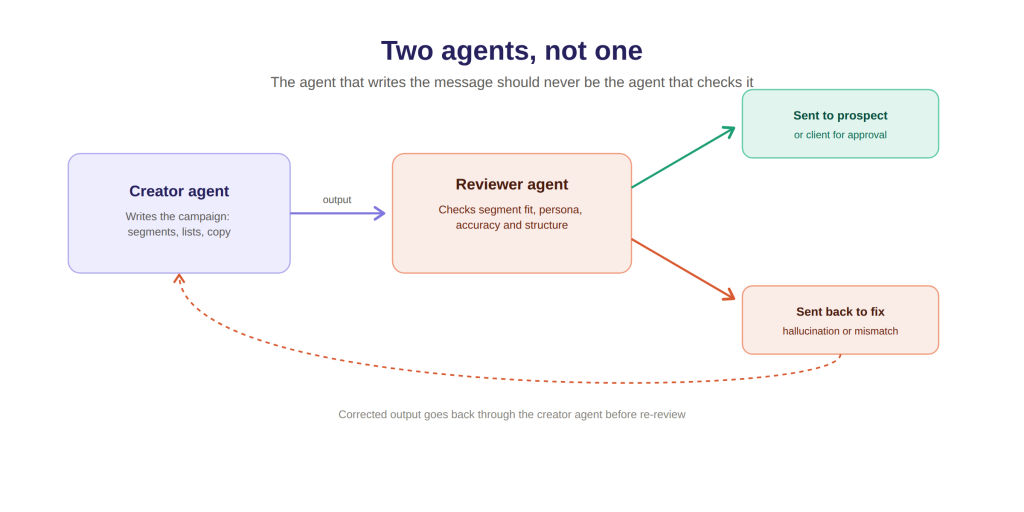
The core insight is this: the agent doing the work and the agent checking the work should never be the same entity. An independent reviewer is the only reliable way to catch what the primary agent missed.
The Persona Problem: Why One Message Fits Nobody
One of the most common cold email quality control failures in automated outbound is treating the contact list as a single audience.
Think about a typical campaign targeting a financial services company. That list might include a junior analyst, a VP of Operations, and a C-suite executive. Each of these people has a completely different frame of reference. What matters to the analyst does not matter to the VP. What moves the executive is invisible to someone three levels below them.
Sending the same message to all three is not personalization. It is a quality failure.
Outbound personalization by persona requires the system to actively differentiate copy based on seniority, function, and role-specific pain points. This is not just about swapping a first name or a company name. It means the hook, the value framing, the social proof, and the call to action should each reflect what a specific type of person actually cares about — the same principle behind signal-based outreach for personalizing cold email at scale, applied here at the review stage rather than the writing stage.
A reviewer agent catches persona mismatches before they go out. It asks:
- Does this message match the seniority of this contact?
- Is the pain point relevant to their function?
- Would this framing land for someone in this role?
Without that validation step, persona-level personalization collapses back to one-size-fits-all.
What a Reviewer Agent Actually Does
A quality assurance agent in an outbound workflow is not a proofreader. Its job is structural validation, not copy editing.
Here is what a properly configured reviewer agent checks:
Segment Fit
Does this contact actually belong in this campaign? The agent cross-references the contact’s firmographic and role data against the campaign’s target segment. If a manufacturing company ends up in a SaaS campaign, the reviewer flags it before the message sends. This is the same fit-checking discipline we cover in validating a new ICP in 30 days using outbound — the reviewer agent is simply enforcing that definition automatically, contact by contact.
Persona Alignment
Is the messaging appropriate for this contact’s seniority and function? The reviewer validates that the copy reflects the right persona, not just any persona.
Message Accuracy
Does the email contain any claims or details that were not sourced from the client brief? This is the AI agent hallucination prevention step. The reviewer compares the message content against the source inputs and flags anything that cannot be traced back to what the client actually provided. It’s the same discipline behind the manual list-review pass we describe in building hyper-targeted prospect lists from public data — someone with context catching what automation alone would miss.
Structural Completeness
Does the message follow the campaign format? Does it have a clear hook, a relevant value proposition, and a specific call to action? Is it the right length for the channel?
The reviewer agent runs after each automated step and again as a final check before anything is sent to the client or launched. This two-layer approach catches errors at the point of creation and again at the point of delivery.
You Have to Define What Good Looks Like First
None of this works without a definition of quality. Automated campaign review requires explicit criteria. If you cannot describe what a good campaign looks like in concrete terms, no agent can validate against it.
Before building a QA layer, you need to answer these questions:
- What makes a contact a valid fit for this campaign? Define the firmographic and behavioral criteria clearly. If you’re building this definition from scratch for a new market, our guide to building an ICP when you have almost no customers yet walks through that first step.
- What does the correct messaging look like for each persona? Write it out by seniority tier and function.
- What information is the agent allowed to use? Define what counts as a hallucination. If the client brief did not say it, the message cannot say it.
- What are the structural requirements? Length, tone, channel-specific formatting, compliance requirements.
These criteria become the rubric the reviewer agent works from. Without this rubric, the agent has no standard to check against and the entire QA layer becomes meaningless.
This step is often skipped because it requires manual thinking before the automation can begin. But it is the most important step in the process. Defining quality upfront is what separates automated outbound that improves over time from automated outbound that runs confidently in the wrong direction. It’s the same lesson we saw play out in our Evoltec case study, where every contact was validated against a clear standard before it ever reached the outreach queue.
FAQ
A reviewer agent is an independent AI component that checks the output of your primary campaign agent against defined quality criteria. It validates segment fit, persona alignment, message accuracy, and structural completeness before anything is sent. It operates separately from the agent that created the content, which is what makes it effective.
Hallucination prevention in cold email requires a QA agent that compares each message against the original source inputs, typically a client brief or campaign document. If the message includes a claim, detail, or framing that cannot be traced back to the brief, the reviewer flags it for correction. This stops the primary agent from inventing details that could embarrass the sender or mislead the prospect.
Different personas have different priorities. A senior decision-maker responds to strategic and commercial framing. A junior buyer or influencer may respond to operational or practical details. Sending the same message to both signals that the outreach is automated and untargeted, which reduces reply rates and damages brand perception. Persona-level differentiation improves relevance and, by extension, results.
Not completely, at least not yet. A QA agent is highly effective at catching structural errors, hallucinations, and persona mismatches at scale. But human review remains valuable for final judgment calls, tone, and nuance. The realistic model is a QA agent that handles the systematic checks, so the human reviewer focuses only on the edge cases that require judgment.
Start by documenting what a correct contact looks like for the campaign, what the messaging should include for each persona tier, what information sources the agent is permitted to use, and what the structural requirements are for each message type. These criteria form the rubric the reviewer agent works from. Without them, automated QA cannot function consistently.
Conclusion
AI-powered outbound can deliver serious pipeline results, but only if the output is actually good. A reviewer agent is the mechanism that keeps automated campaigns honest. It catches hallucinations, enforces persona alignment, and validates every contact against the segment criteria before anything reaches a prospect’s inbox.
The prerequisite is always the same: define what good looks like before you automate anything. Once you have that definition, a QA layer built around an independent reviewer agent will consistently improve output quality and protect your brand at scale.
If you want outbound that runs reliably without constant manual oversight, the reviewer agent is not a nice-to-have. It is the thing that makes the whole system work. See how this looks across real accounts on our case studies page, or get in touch to talk through your own QA setup.