
Most outbound advice assumes you’re selling into a broad, well-defined market. Plenty of prospects, plenty of data, plenty of room to test and iterate. But what happens when your ICP is a narrow slice of a specific industry — say, thermal processing equipment manufacturers, or RFID hardware integrators, or specialised compliance software for a single regulated sector?
The rules change. And most generic outbound playbooks don’t account for that.
This article breaks down how outbound for niche B2B markets works differently — from the way you write your messages to the way you build your lists, choose your decision-makers, and decide whether to reach out in English or the buyer’s native language. If your target market is tight, these distinctions aren’t marginal. They’re the difference between a campaign that lands and one that gets ignored.
Why Generic Templates Fail in Tight Verticals
There’s a simple reason generic cold email templates don’t work in niche B2B markets: buyers immediately know they weren’t written for them.
In a broad SaaS market, a buyer might skim a cold email and think, “okay, this is a template, but it’s relevant enough.” In a specialised industrial or professional services market, the same email reads like a red flag. It signals that the sender doesn’t understand the industry, the buying process, or the actual problem they’re claiming to solve.
Cold email industry targeting in niche markets requires real subject matter fluency. You need to know:
- The terminology buyers use internally (not the vendor’s marketing language)
- The specific pain points that are live right now in that vertical
- Which problems are genuinely unsolved versus already addressed by a legacy solution
- What a realistic buying cycle looks like — and who’s involved in it
For example, outreach targeting manufacturing companies often fails because it treats operational buyers the same way you’d treat a SaaS decision-maker. A plant manager or procurement lead doesn’t want to “hop on a quick call to explore synergies.” They want to know if your solution reduces downtime, integrates with their existing line, and has been proven in a comparable environment. The framing is completely different.
When your email demonstrates actual industry knowledge — even in subtle ways, like referencing a common operational constraint or a regulatory shift affecting their sector — response rates improve meaningfully. Buyers notice.
ICP Precision Matters More Than Volume
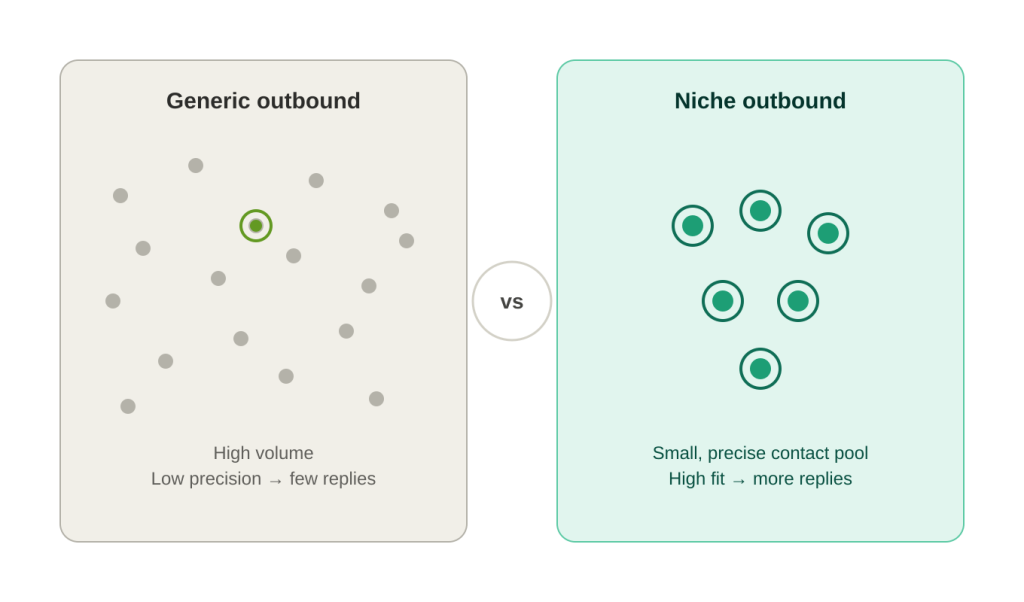
In a large, horizontal market, you can compensate for loose targeting with volume. Send enough emails, and the numbers will eventually work in your favour. In a niche market, that logic breaks down fast.
The total addressable contact pool may be small — sometimes a few hundred companies globally, sometimes a few thousand. ICP precision outbound isn’t just a nice-to-have in these markets. It’s the only viable approach.
This changes how you think about list building entirely:
- Quality over size. Every contact on your list needs to meet a specific set of criteria. One irrelevant send is a wasted opportunity in a market where you might only have 500 realistic prospects.
- Signals matter more than firmographics. Company size and revenue are useful filters, but in niche markets, buying signals — recent investment, new product launches, regulatory changes, expansion into new geographies — tell you far more about who’s actually in-market.
- Decision-maker identification is harder. In complex B2B niches, the actual buyer isn’t always the person with the most obvious job title. A procurement director might sign the contract, but the real driver could be a technical lead, a quality manager, or even a regional site head. Getting this wrong wastes your limited pool of contacts.
This is where tools like Clay become genuinely useful — not to spray more emails, but to enrich a small, precise list with the kind of signals that tell you who to contact, when, and with what message.
Tone, Formality, and Language: Getting the Culture Right
Different industries carry different communication norms — and in niche markets, those norms are often more rigid than in tech-forward sectors.
B2B outreach in niche markets frequently fails because of tone mismatch. A casual, first-name-basis email with a breezy subject line might perform well when targeting startup founders. Send the same message to a senior engineer at a family-owned industrial company, and it feels out of place. Not offensive — just off. And that’s enough to kill a response.
Some practical adjustments for niche B2B outreach:
- Match the formality of the sector. Regulated industries (finance, pharma, legal) tend to expect more formal communication. Industrial manufacturing often sits somewhere in the middle — professional but direct.
- Avoid buzzwords that don’t translate. Terms like “growth hacking,” “synergy,” or “disruptive solution” land poorly in sectors where buyers are skeptical of over-promises.
- Consider local language outreach. This is one of the most consistently underrated levers in niche B2B outbound. If your target companies are predominantly based in a specific region — Germany, Poland, France, the Netherlands — outreach in their native language almost always outperforms English. It signals respect, reduces friction, and makes your message feel less like a mass blast.
In practice, a manufacturing client targeting Polish companies will typically see higher reply rates from a Polish-language campaign than from an equivalent English version — even if the company also operates internationally. The buyer is more comfortable in their own language, and the outreach feels more considered.
Adapting Your Sequencing and Timing for Niche Markets
Niche B2B buyers often have longer evaluation cycles, more stakeholders involved, and less urgency to respond to cold outreach. This affects how you structure your sequences.
A few principles worth building around:
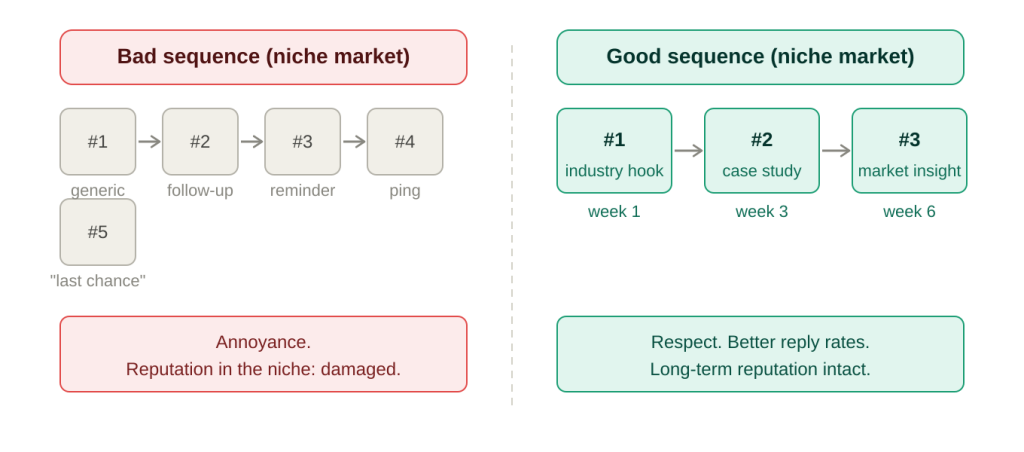
- Fewer, better touches beat high-frequency sequences. Bombarding a small pool of contacts with five follow-ups in two weeks damages your reputation in a market where everyone knows everyone. Three well-spaced, high-quality touches tend to perform better.
- Follow-up messages should add value, not just nudge. In tight verticals, a follow-up that references something relevant — an industry development, a common challenge, a specific use case — will always outperform “just checking in.”
- Respect buying cycles. Some industries have strong seasonal patterns or budget cycles that affect when decisions get made. Understanding these patterns and timing outreach accordingly can have a significant impact on results.
- Account for longer sales cycles in your expectations. A niche manufacturing company isn’t going to book a meeting within 48 hours of a first email. Patience — and consistent presence — matter more than conversion speed.
FAQ
Why does generic outbound fail in niche B2B markets?
Generic outbound templates are written for broad audiences, which means they lack the industry-specific language, context, and credibility that niche buyers expect. In tight verticals, buyers are quick to identify — and dismiss — messages that feel templated or out of touch with their actual challenges.
How important is local language outreach in niche B2B campaigns?
Very important. When your target companies are concentrated in a specific region, outreach in the buyer’s native language typically outperforms English campaigns. It signals familiarity with the market, reduces cognitive friction, and often results in higher reply rates — even when the product is sold internationally.
What does ICP precision mean in practice for niche markets?
ICP precision means defining your ideal customer profile tightly enough that every contact on your list is a genuine fit — not just by industry or company size, but by buying signals, role, and current context. In niche markets with small contact pools, wasting outreach on poor-fit contacts is a much bigger problem than in broader markets.
How should I adjust email tone for cold email manufacturing outreach?
Manufacturing buyers tend to value directness and specificity over enthusiasm and jargon. Keep your tone professional but grounded. Reference real operational challenges rather than abstract value propositions. Avoid startup-style language and focus on concrete outcomes — reduced downtime, cost savings, integration with existing systems.
How many follow-ups should I send in a niche B2B outbound campaign?
Fewer than you might in a broader campaign. In tight verticals, over-sequencing can damage your reputation in a market where buyers are closely connected. Three well-spaced, value-adding follow-ups are typically more effective than five or more generic nudges.
Conclusion
Niche B2B markets reward depth over scale. Generic messaging, imprecise lists, and tone-deaf sequencing all fail faster — and more visibly — in tight verticals than in broad ones. The companies that succeed with outbound for niche B2B are the ones that invest in genuine industry understanding before they send a single email.
The fundamentals of good outbound still apply: precise targeting, relevant messaging, respectful sequencing. But in specialised markets, each of those fundamentals requires more care, more context, and more patience.
If your product sells into a niche vertical and your outbound results have been inconsistent, it’s worth asking whether your current approach was really built for your market — or just borrowed from a playbook designed for someone else’s.
At Outbound Republic, we build outbound systems designed around your specific ICP — not generic templates. If you’re selling into a specialised market and want a prospecting engine that actually fits your context, let’s talk.