

A prospect replies to your cold email: “Interesting, can you send me more info?”
Who answers? How quickly? And if the next reply is “not now, maybe next quarter,” where does that lead go?
Most teams cannot answer these questions without an argument. Sales thinks marketing sends poor leads. Marketing thinks sales ignores what it receives. Meanwhile, the prospect who showed interest waits, and cools off.
Most advice on sales and marketing alignment assumes an inbound flow: marketing generates a lead, sales follows up. Outbound works differently, and so do its handoffs. This post covers who should own a lead at each stage, what should trigger a handoff, and where it usually breaks.
Why outbound alignment is different
In an inbound flow:
- The prospect raises a hand (a form, a download, a demo request)
- Marketing qualifies and scores the lead
- Sales picks it up
In an outbound flow:
- Sales, an SDR or an agency starts the conversation
- The lead usually belongs to the sales side from the first touch
- Marketing supports from the background
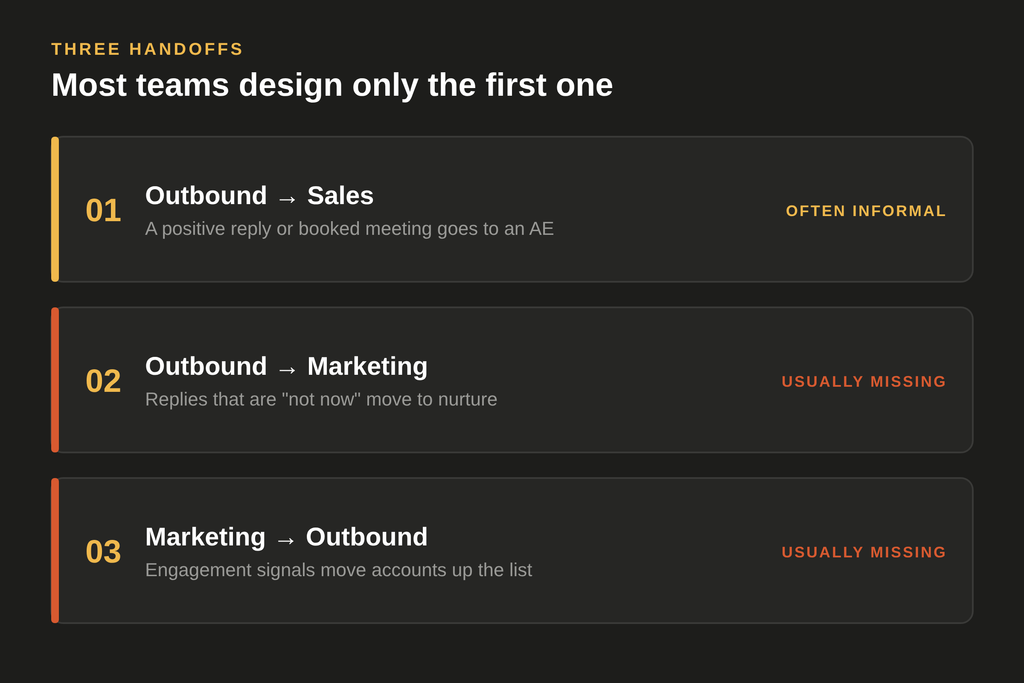
That changes where the handoffs happen. Three of them matter:
- Outbound to sales: a positive reply or booked meeting moves to an account executive
- Outbound to marketing: replies that are not ready yet move to nurture
- Marketing to outbound: engagement signals move accounts up the outreach list
Most teams only design the first one, and even that one is often informal.
Start with one definition of a lead
Before assigning owners, agree on what you are handing off. If sales and marketing mean different things by “qualified,” every handoff turns into a dispute.
We covered why this happens in what a lead is and why sales teams define it differently. For outbound, a simple three-stage version is usually enough:
- Reply: the prospect responded in any way
- Qualified conversation: the prospect showed real interest and fits your ICP
- Sales opportunity: a meeting is booked or a buying process has started
For each stage, write down:
- What has to be true for a lead to enter it
- Who owns it
- What happens next
If it takes more than a page, it is too complicated to be used.
Handoff 1: outbound to sales
This is the one that costs the most when it fails, because the prospect is actively interested.
Decide in advance:
- Trigger: what counts as ready to pass on (a positive reply, a request for a call, a booked meeting)
- Owner: who responds, the SDR, the agency or the account executive
- Speed: how quickly someone must respond (set a target you can actually keep, and measure it)
- Channel: whether the reply continues in the original thread
Once the handoff exists, the next question is what happens to the lead after it, which we cover in how to qualify outbound leads properly.
Pass along more than a name. The person taking over should receive:
- The full email or LinkedIn thread, not a summary
- The reason the account was targeted (the signal, the ICP match, the trigger)
- Anything promised in the conversation, such as a resource, a pricing question or a specific date
- Any objections or questions already raised
A lead who has to explain their situation twice usually does not explain it a third time.
Handoff 2: outbound to marketing
Not every reply is a “yes.” Many are some version of “not now” or “not me,” and these are where leads quietly die.
Typical outcomes and what should happen:
| Reply | Owner | What should happen |
|---|---|---|
| Positive, wants to talk | Sales | Respond fast, book the meeting |
| “Not now, try next quarter” | Marketing, with a sales reminder | Add to nurture, set a date to re-contact |
| “Wrong person, try X” | Outbound | Contact the right person, note the referral |
| “Not interested” | Outbound | Mark and suppress, do not keep emailing |
| “Remove me” | Whoever sees it first | Add to do-not-contact across every tool, immediately |
The “not now” row is the one most teams lack. Without a defined path, those prospects either get contacted again too soon, which annoys them, or never again, which wastes the work already done.
Marketing is well placed to keep these contacts warm with relevant content, events and updates, until the timing is right.
Handoff 3: marketing to outbound
The third handoff runs the other way. Marketing often sees buying interest before sales does:
- A target account visiting your pricing page
- Several people from one company reading your content
- A registration for your webinar or event
These signals should change who gets contacted and when. If you run account-based programs, combining ABM and outbound goes deeper. We cover the signal mechanics in using website visitor data for cold outreach and using event registrant data as an outreach signal.
For this handoff to work:
- Marketing shares a list of engaged accounts on a regular rhythm
- Outbound knows what the engagement was, so the message can reference it
- Both sides agree what is fair to mention (a prospect should not feel watched)
Where handoffs usually break
Most failures come from a short list of causes:
- No named owner for replies. Everyone assumes someone else is answering.
- Different definitions of “qualified.” Sales rejects what marketing passes, marketing stops trusting sales feedback.
- No path for “not now.” Interested people fall out of every process.
- Conflicting contact. A prospect gets a marketing email, an SDR sequence and an agency message in the same week, each saying something different.
- Unshared suppression lists. Someone who opted out in one tool keeps receiving messages from another. Beyond annoying people, this creates legal exposure in the EU.
- Slow response. A positive reply that sits for days has already lost much of its value.
Build a feedback loop in both directions
Handoffs are not one-way. The best-aligned teams keep information moving in both directions.
Sales to marketing:
- Which objections come up most
- Which industries and roles respond
- Which messages and content pieces prospects mention
Marketing to sales and outbound:
- Which accounts are engaging
- Which content pieces keep appearing in deals
- Which segments respond to campaigns
A short, regular meeting is enough, weekly or fortnightly, with a fixed agenda: what moved, what stalled, what we change.
Share metrics, not just activity. If marketing is measured on leads generated and sales on meetings held, they will optimize for different outcomes. A shared set works better:
- Positive reply rate
- Meetings held (not just booked)
- Opportunities created
- Pipeline from accounts both teams touched
If an agency runs your outbound
When outbound is outsourced, the handoff crosses a company boundary, which makes unclear ownership more expensive. Agree these points before the first campaign:
- Who answers positive replies, and within what time
- Who owns “not now” leads, and where they go
- How the agency learns what happened to a lead after the handoff (meeting held, opportunity created, closed lost)
- How your marketing team’s activity and the agency’s sequences stay out of each other’s way
- Which tools hold the master do-not-contact list
Our guides on what to expect in the first 90 days with an outbound agency and on how to brief a lead gen agency cover related ground, and agreeing the handoff early belongs on the same checklist.
A five-question check for your own team
If you cannot answer all five in one sentence each, your handoff has a gap:
- Who responds to a positive reply, and how fast?
- What is passed along with the lead?
- Where does a “not now” reply go?
- How do engaged accounts get from marketing to outbound?
- Where is the single list of people who must not be contacted?
The point
Alignment is not a meeting, a tool or a shared Slack channel. It is a small set of agreements: who owns each stage, what triggers a handoff, and what information travels with the lead. Written down and reviewed regularly, those agreements keep interested prospects from falling between teams.
If you would rather have the outbound side, including the handoffs, run by a team that does it every day, see our cold email outreach service or get in touch.