

Most B2B companies sign a contract with a lead generation agency and then wait for results. What they forget is that the agency can only be as good as the information they receive. A vague brief leads to misaligned campaigns, wasted budget, and a frustrating first 60 days for everyone involved.
The good news is that fixing this is straightforward. A solid lead gen agency brief does not require a 40-page document. It requires the right information, clearly communicated, before the outbound agency onboarding process begins.
This article walks you through exactly what to prepare, why it matters, and what most clients overlook before their B2B outbound kickoff.
Why a Weak Brief Kills Campaigns Before They Launch
Agencies move fast. Once onboarding starts, copywriters begin drafting, list builders start scraping, and domains get warmed up. If your ICP definition is fuzzy or your value proposition is unclear, all of that work is built on a shaky foundation.
The most common mistake is treating the brief as a formality. Clients fill in the basics, industry and company size, and assume the agency will figure out the rest. But that assumption is expensive.
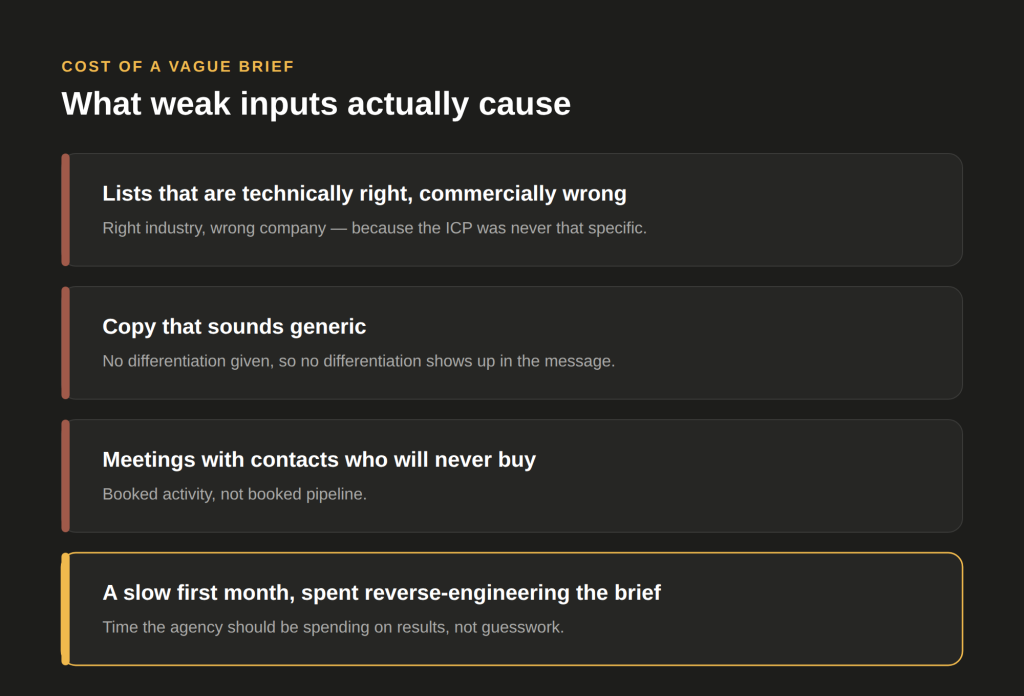
A poor brief typically causes:
- Prospect lists that are technically correct but commercially wrong
- Email copy that sounds generic and fails to resonate
- Meetings booked with contacts who will never buy
- A slow first month while the agency tries to reverse-engineer what you actually need
Getting your brief right is the single fastest way to compress time-to-results.
What Your ICP Definition Needs to Include
Your Ideal Customer Profile is the foundation of every list, every message, and every campaign decision. Most clients provide something like “mid-size SaaS companies in Europe.” That is not enough. As we’ve covered when building a clean, targeted prospect list, your ICP is the blueprint everything else gets built from — and a vague blueprint produces a vague list no matter how good the agency’s tooling is.
A useful ICP for a lead gen agency brief goes deeper than industry categories. It defines the specific conditions that make a company a genuine buying opportunity.
Firmographic criteria your brief should include:
- Employee count range (be specific, not just “SMB”)
- Revenue range or funding stage if relevant
- Industry verticals, including ones you want to exclude
- Geography down to country or region level
- Business model (do they sell B2B or B2C?)
Behavioural and situational signals to add:
- Buying triggers such as recent hires, new funding rounds, or technology changes
- Tools or tech stack they are likely using
- Signs they have already tried to solve the problem you solve
- Red flags that disqualify a company, even if they fit the firmographics
The goal is to give your agency enough specificity to filter a list of 10,000 companies down to 400 real prospects. Without this, they are guessing. If your ICP is still more of a hypothesis than a proven definition, it’s worth treating the first weeks of the engagement as a structured validation phase rather than an assumption everyone quietly hopes is right.
Defining Your Value Proposition Before Copy Gets Written
No copywriter, no matter how experienced, can write a compelling cold email without understanding what makes your offer genuinely different. This is one of the most overlooked parts of outbound agency onboarding.
Before your B2B outbound kickoff call, you need to be able to answer these questions clearly:
The core four:
- What specific problem do you solve?
- Who suffers from that problem most acutely?
- What does your solution do that alternatives do not?
- What result do clients typically see, and how fast?
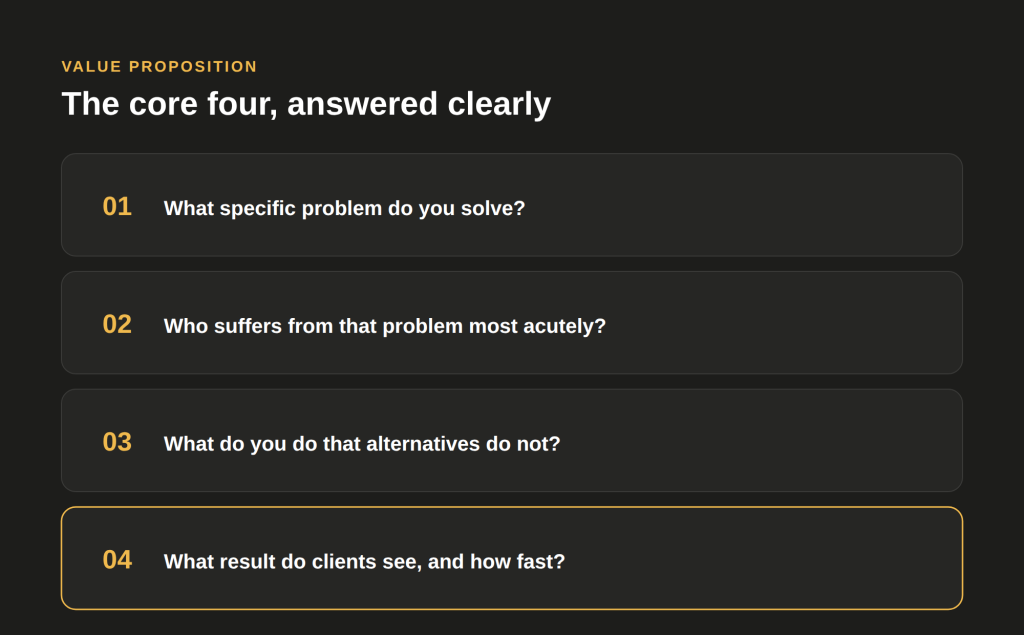
These answers feed directly into subject lines, opening hooks, and calls to action. If your answer to question three is “we’re better and cheaper,” your campaigns will underperform. The sharper your differentiation, the better the copy. Agencies that test multiple distinct messaging angles rather than a single value proposition guess can find what resonates faster, but they can only run that process if you’ve given them real raw material to start from.
It also helps to share real examples of clients you have won and why they chose you. Even anonymised, these stories give copywriters language, framing, and angles that no amount of website copy can provide.
Defining What a Qualified Response Looks Like
This is the step that almost every client misses, and it creates enormous problems down the line.
Agencies can book meetings. But if your team does not know what a good meeting looks like, you will end up with a calendar full of calls that go nowhere. Worse, you might blame the agency for poor lead quality when the real issue is that your team is not filtering effectively. It helps to align on what actually counts as a lead before the campaign starts, since sales and marketing teams often define the term differently even within the same company.
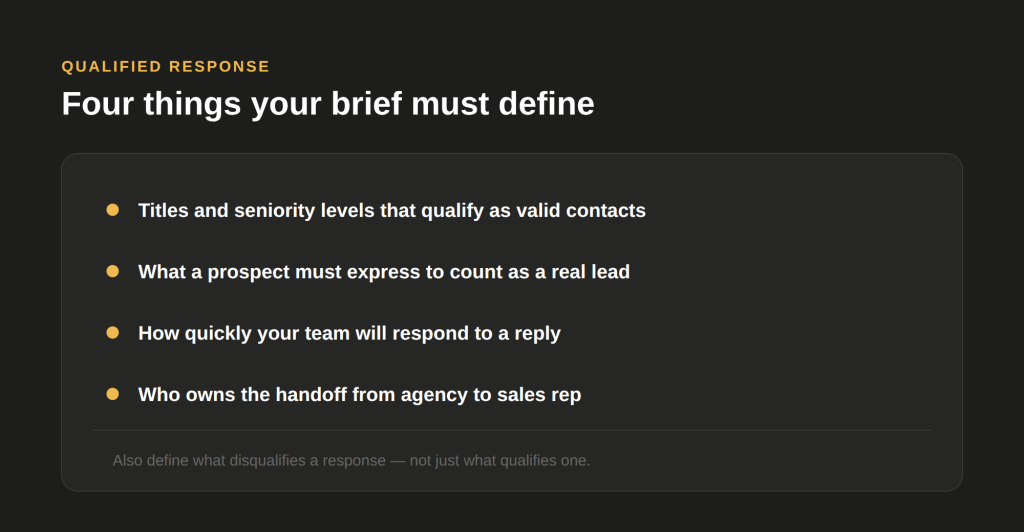
Your brief should define:
- What titles and seniority levels qualify as valid contacts
- What a prospect needs to have acknowledged or expressed to count as a real lead
- How quickly your team will respond to a reply
- Who owns the handoff from agency to sales rep
Speed-to-lead matters more than most companies realise. A prospect who replies to a cold email on a Tuesday morning and hears back on Thursday afternoon is already less warm. In fact, the odds of a successful conversation drop sharply within the first few hours of a lead coming in, which is why response time deserves its own line in the brief rather than being left as an assumption. Define your response expectations in the brief so the agency can calibrate timing and messaging accordingly.
Equally important: define what disqualifies a response. If someone replies but is clearly a junior researcher with no budget authority, your team needs to know how to handle that without wasting a senior AE’s time.
The Onboarding Information Most Clients Forget to Share
Beyond the ICP and value proposition, there is a category of practical information that agencies need but rarely receive upfront. Skipping this slows down your B2B outbound kickoff by days or weeks.
Include in your brief:
- Competitor names you want to avoid targeting (their customers, or the companies themselves if conflict of interest applies)
- Existing accounts that should be excluded from outreach entirely
- Previous outreach history including tools used, sequences run, and which messages have already been sent to your market
- Brand tone guidelines even a short note on formal versus casual, UK versus US spelling, or words you never use
- Legal or compliance constraints particularly relevant for regulated industries or markets under GDPR
- Domain and email preferences including whether you want to retain ownership of outreach domains after the engagement
That last point is often overlooked. Some agencies purchase domains on platforms that do not allow domain transfers. If owning those assets matters to you, say so before the campaign launches.
FAQ
A lead gen agency brief is the document or set of information you share with your agency before a campaign begins. It covers your ICP, value proposition, target markets, and qualification criteria. Without a thorough brief, agencies cannot build accurate prospect lists or write relevant copy, which directly affects campaign performance.
Very specific. Industry and company size are a starting point, not a complete ICP. You should include employee count ranges, geography, tech stack signals, buying triggers, and disqualifying characteristics. The more precisely you define your ideal prospect, the more accurate the list and the more relevant the outreach.
A qualified response is any reply from a prospect that meets your minimum criteria for a sales conversation. This typically includes the right seniority level, an expressed problem or interest, and the authority to make or influence a buying decision. Define this clearly in your brief so both your agency and your sales team are aligned from day one.
Most onboarding processes take one to two weeks before outreach begins. This covers brief review, list building, copywriting, domain setup, and warm-up periods for email infrastructure. A complete and clear brief at the start can shorten this timeline significantly, though it’s worth remembering that meaningful campaign data still takes four to eight weeks of consistent sending to materialise even after a perfect kickoff.
Yes, and you should. Sharing previous sequences, open rates, reply rates, and any feedback from prospects helps the agency understand what has already been tried and what angles to avoid or build on. This context is valuable and saves time.
Conclusion
A strong lead gen agency brief is not a nice-to-have. It is the difference between a campaign that builds momentum in week two and one that spends the first month correcting course. Define your ICP with real specificity, clarify your value proposition before any copy is written, and spell out what a qualified response looks like for your team.
If you are preparing for a B2B outbound kickoff and want to make sure you are set up for success from day one, start with the brief. Everything the agency builds will follow from it. If you’d rather work through that ICP and messaging hypothesis together before committing to a full campaign, our GTM market validation process is built for exactly that starting point.
Ready to launch outbound that actually fills your pipeline? Share the right information upfront, get in touch, and the results will follow.