
Most cold email sequences fail before the second message is ever opened. Not because the product is wrong, or even because the targeting is off. They fail because each email feels like a fresh interruption rather than a continuation of something meaningful.
A well-built cold email sequence should feel like a conversation. Each message picks up where the last one left off, adds something new, and moves the prospect closer to a decision, without pressure. That is the difference between a sequence that generates replies and one that generates unsubscribes. We’ve covered the fundamentals of what makes a single cold email earn a reply before; this piece goes deeper into how those individual messages need to connect across a full sequence.
In this article, you will learn the core principles behind email sequence structure: how to lead with the right first message, how to anchor each follow-up to what came before, and how to close the sequence in a way that reopens doors instead of slamming them shut.
The First Email Is Not a Sales Pitch
This is where most outbound email strategy goes wrong immediately. The first message in a cold email sequence tries to do too much. It explains the product, lists the benefits, includes a case study link, and ends with “Would you be open to a 30-minute call?”
That is not a conversation starter. It is a monologue.
The first email has one job: earn a reply. To do that, it needs to feel relevant, not rehearsed.
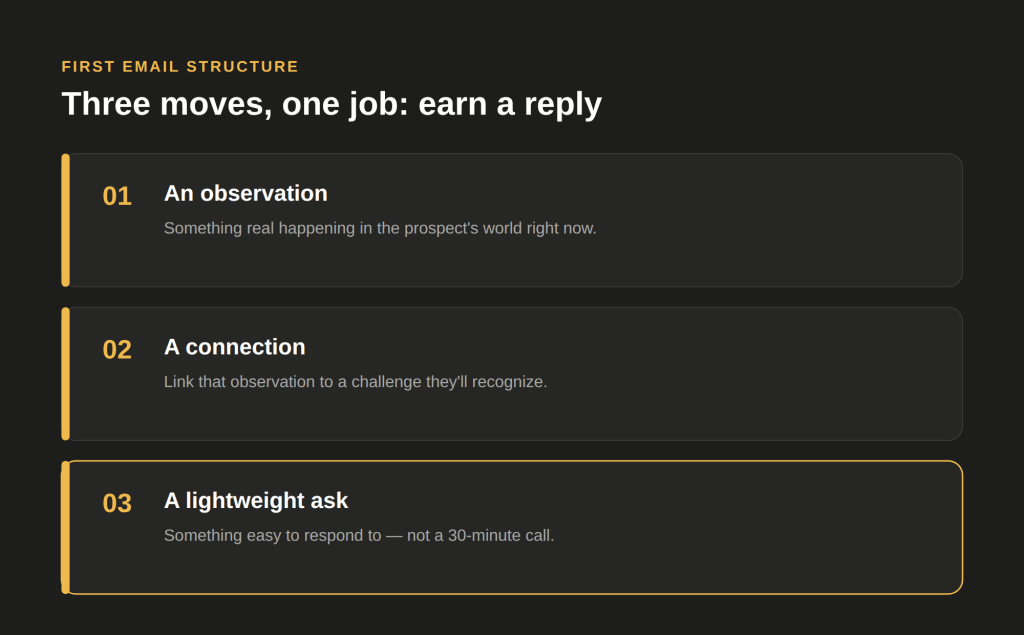
The most effective opening structure is simple:
- An observation about something happening in the prospect’s world
- A connection between that observation and a challenge they might recognize
- A lightweight ask, something easy to respond to
Strong observations come from real signals. A company scaling its sales team. A job posting that hints at a gap in their process. A shift in their market that creates new pressure. When you lead with something the prospect already knows to be true, you create instant relevance. This is the same logic behind signal-based opening lines that reference something specific and timely about the prospect’s situation, rather than a generic “I saw your company online.”
The goal is not to impress them with your product. It is to make them feel understood. People respond when they feel respected, not when they feel sold to.
How Anchoring Makes Follow-Ups Feel Natural
Here is where most cold email follow-ups fall apart. They treat each message as a fresh attempt, restarting from zero. “Just following up on my last email” is not a follow-up. It is a reminder that you have not given them a reason to respond yet.
Each follow-up should anchor to something specific from the previous message. If your first email made an observation, your second email should deepen it. Add evidence. Share a brief example. Show that the challenge you identified is real and worth taking seriously.
Think of it this way:
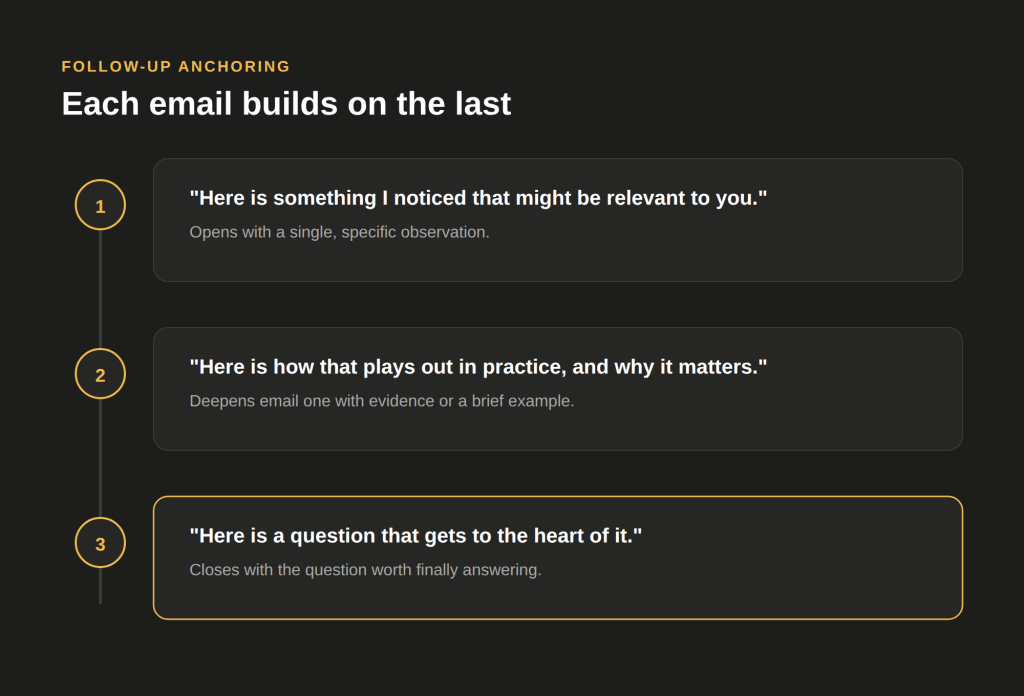
- Email 1: “Here is something I noticed that might be relevant to you.”
- Email 2: “Here is how that plays out in practice, and why it matters.”
- Email 3: “Here is a question that gets to the heart of it.”
This structure creates forward momentum. Each message builds on the last instead of competing with it. It’s consistent with what tends to hold true across most B2B campaigns: most replies come from follow-ups rather than the first email, provided each one adds new value instead of simply restating the original message. The prospect who did not reply to email one might engage at email two because now there is more context. They might finally respond at email three because the question you asked is one they genuinely want to think about.
This is not manipulation. It is good communication. It mirrors how real conversations work.
The Role of Evidence and Provocation in the Middle Messages
Once you have made your opening observation, the middle of your cold email sequence needs to add weight to it. This is where most sequences go quiet or generic. They repeat the pitch from email one with slightly different wording.
Instead, use the middle messages to do one of two things:
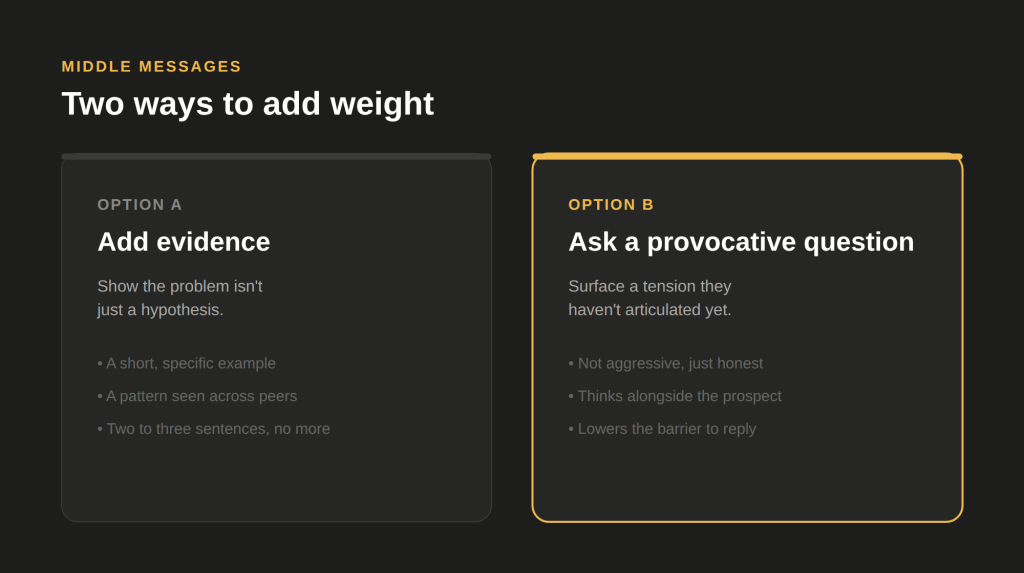
Add evidence. Show that the problem you identified is not just a hypothesis. A short example, a pattern you have seen across similar companies, or a specific outcome that became possible once the problem was addressed. Keep it brief. Two to three sentences is enough.
Ask a provocative question. This is sometimes called “poking the bear.” Not in an aggressive way, but in a way that surfaces a tension the prospect probably has not articulated yet. Something like: “How do you currently know if what your team learned in training is actually changing how they behave?” That kind of question lands differently than “Would you like to see a demo?”
Provocative questions work because they are intrinsically interesting. They are not selling. They are thinking alongside the prospect. And when a prospect reads a question they find genuinely worth answering, the barrier to replying drops significantly. It’s also worth treating opens-without-replies as their own segment worth a different approach, rather than more of the same message — prospects who opened but never engaged deserve a different follow-up path than those who never opened at all.
Structuring the Final Message Without Burning the Bridge
The last email in a cold email sequence has a delicate job. It needs to reengage prospects who have not responded, without sounding desperate or passive-aggressive.
Avoid the classic mistake of the guilt-driven final email. “I have tried reaching you several times and will take your silence as a no.” That framing creates friction and closes the door permanently.
A better approach is the honest, low-pressure close:
- Acknowledge that the timing may not be right
- Offer one final thought, a question or insight that links back to the original observation
- Make it genuinely easy to say no
Something like: “If this is not a priority right now, that makes sense. But if the question I raised earlier is something you are still thinking about, I am happy to share how we have approached it with others in a similar position.”
This kind of message respects the prospect’s autonomy. It does not push. It invites. And because it is honest, it often gets replies weeks or months later when the timing does shift. Getting the spacing right matters here too — research on send timing shows open rates, reply rates, and meeting bookings fluctuate depending on the day and time you hit send, which applies as much to when your final message lands as to the first one.
A sequence that ends gracefully keeps the relationship open. That matters in B2B sales, where buying cycles are long and circumstances change.
FAQ
Most B2B cold email sequences run between three and five messages. Fewer than three often means you give up before the prospect has had enough exposure to respond. More than five can start to feel like harassment. Three to four is the sweet spot for most outbound email strategies.
A common rhythm is two to three days between the first and second email, then four to five days before the third, and five to seven days before any final message. This spacing feels natural rather than relentless, and it gives prospects time to engage on their own terms.
Yes, but the CTA should match the stage of the sequence. Early emails should use lighter asks, such as a yes/no question or a request to confirm relevance. Later emails can shift toward booking a short call. Asking for a 30-minute meeting in email one sets the bar too high too early.
A true follow-up adds something new: a piece of evidence, a different angle, or a question that deepens the original point. Simply resending the same email or changing a few words does not give the prospect a new reason to respond. Each message should earn its place in the sequence.
Reply rate is the primary signal, but it shouldn’t be the only one you track. If your open rates are strong but replies are low, the sequence logic or the messaging is the issue, and it’s worth checking your numbers against the broader set of outbound metrics that actually correlate with pipeline, not just activity.
Conclusion
A cold email sequence is not a list of individual emails. It is a structured conversation with a beginning, a middle, and a thoughtful close. When each message anchors to the last, adds something meaningful, and respects the prospect’s time and intelligence, the whole sequence starts to feel less like outreach and more like a relevant, timely interaction.
Lead with an observation. Build with evidence. Close with respect. That is the framework behind every cold email sequence that consistently generates replies.
If you want to see what a properly structured outbound email strategy looks like in practice, our fully managed cold email service builds sequences on exactly this logic. And if your current sequences are not converting the way they should, it is worth getting in touch to take a closer look at how each message is earning its place in the flow.