

Most cold emails fail before they’re even read. The subject line is vague, the opener is about the sender, and the call to action asks for too much from someone who has no idea who you are. The result: ignored, deleted, or marked as spam.
Learning how to write cold email that actually gets a response is not about tricks or templates. It is about understanding what your prospect is thinking when that email lands in their inbox, and giving them a reason to keep reading. If you want the deeper testing framework behind these principles, our companion piece on cold email copywriting and what makes a message actually get replies walks through the iterative process in more detail.
This article breaks down the full anatomy of a high-performing cold email, from subject lines to sign-offs. Whether you are new to B2B cold outreach or trying to improve a campaign that is not performing, these principles will help you write messages that earn replies.
The One Question Every Cold Email Must Answer
Before you write a single word, ask yourself one question: why should this specific person read this right now?
If you cannot answer that clearly, neither can your prospect. And they will not try.
This is the root cause of most cold email failure. Senders focus on what they want, a meeting, a response, a conversation, rather than what makes the email relevant to the person receiving it. The reader does not care about your company. They care about their own problems, priorities, and pressures. This is the same behavioral pattern we unpack in the psychology of cold outreach and why people reply — relevance and curiosity aren’t stylistic choices, they’re what actually gets a brain to engage.
A relevant cold email does one of two things:
- It connects to something happening in the prospect’s world (a trigger, a role change, a company initiative)
- It speaks directly to a problem they are likely experiencing given their role or industry
The more specific your relevance, the higher your cold email reply rate. Generic relevance is no relevance.
Context Builds Trust
One of the most underrated elements of cold email copywriting is context. Explaining why you are reaching out, not just what you want, dramatically changes how the message lands.
Compare these two openers:
Without context: “Hi Sarah, I wanted to connect about how we help sales teams improve pipeline.”
With context: “Hi Sarah, I came across your profile after seeing your company recently expanded into the enterprise segment. That usually means the prospecting workload increases fast.”
The second version tells the reader why this email arrived. It signals that you did some homework. That alone increases trust and makes the next sentence worth reading. This is exactly the mechanism behind signal-based outreach for personalizing cold email at scale — one real signal, woven into the opener, does more work than a paragraph of generic pitch.
Cold Email Structure: What Goes Where
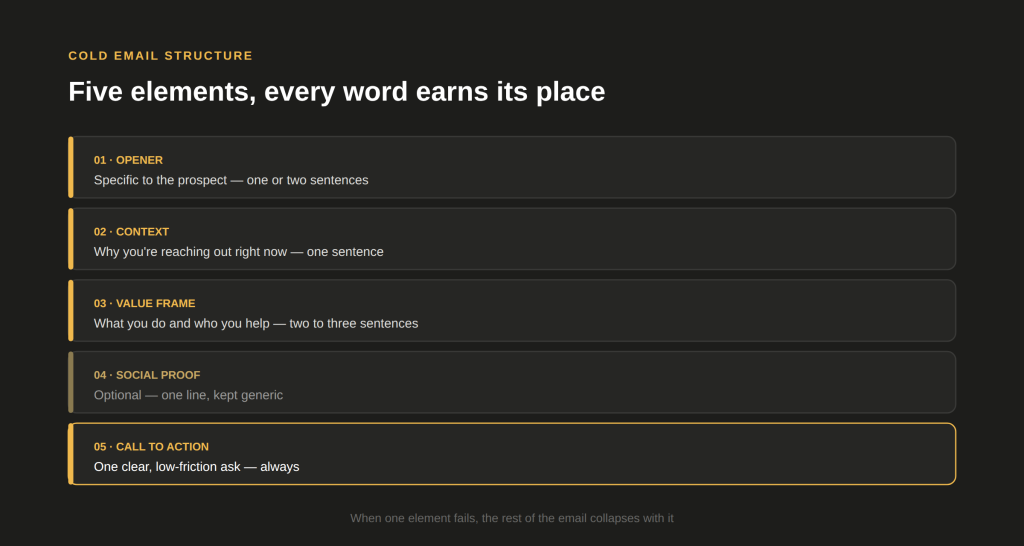
Cold email copywriting is not about being clever. It is about being clear. Every element of the email has a job to do, and when one element fails, the rest collapses with it.
Subject Lines
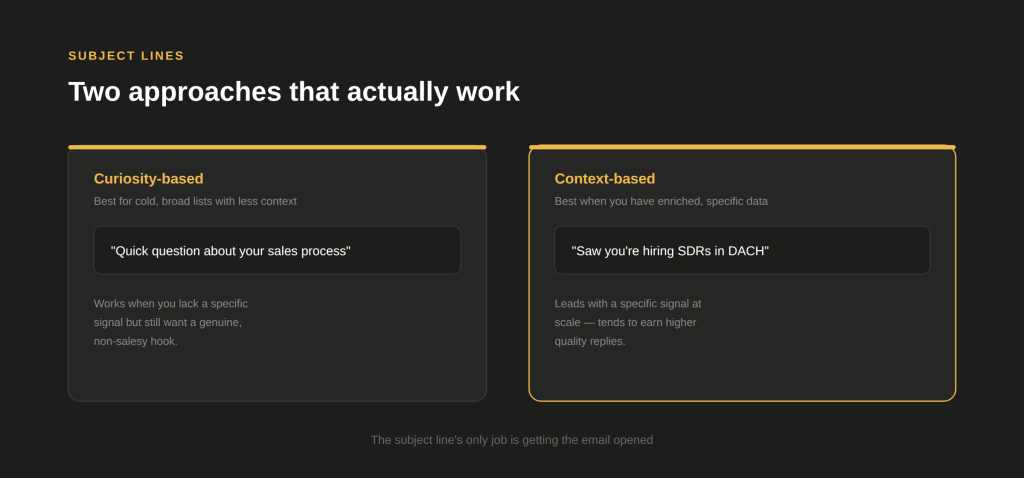
The subject line has one job: get the email opened. That is it.
Effective subject lines are short, specific, and avoid sounding like marketing copy. They either create genuine curiosity or signal direct relevance.
Examples of approaches that work:
- Curiosity-based: “Quick question about your sales process” (works when the audience is broad and you lack deep context)
- Context-based: “Saw you’re hiring SDRs in DACH” (works when you have a specific signal and want to lead with it)
Curiosity-based subject lines work best when your list is cold and diverse. Context-based subject lines perform better when you have enriched data and can personalize at scale. Both have a place in B2B cold outreach, but the context-based approach tends to earn higher quality replies. Keep in mind that subject lines also carry deliverability weight — our breakdown of what Google’s 2025 spam changes mean for B2B cold email covers how Gmail’s filters now weigh subject line and content quality alongside authentication.
The Opening Line
Do not start with “I hope this finds you well.” Do not open with your company name or what you do. Start with the prospect.
A strong opening line does one of three things:
- References something specific about their company or role
- Names a problem they are likely dealing with
- Asks a short, sharp question that makes them want to answer
The first two sentences determine whether the rest of the email gets read. Treat them like the most valuable real estate in the whole message.
The Value Frame
Once you have their attention, explain what you do in terms of the outcome it creates, not the features it includes. Keep it to two or three sentences maximum.
Your prospect does not need to understand everything about your product in the first email. They just need to understand whether there is a reason to have a conversation.
A useful formula: “We help [type of company] achieve [outcome] by [brief mechanism].”
Length vs. Structure: What Actually Matters
There is a persistent debate in cold email copywriting about whether short or long emails perform better. The honest answer is that structure matters more than length.
A 400-word email with a clear point, logical flow, and a single ask can outperform a 100-word email that is vague and confusing. That said, short conversational emails often outperform long pitch-heavy ones for a simple reason: they feel more human.
When an email reads like a brochure, it gets treated like one. When it reads like a message from a real person who did their homework, it gets a reply.
A solid cold email structure for B2B outreach looks like this:
- Opener – Specific to the prospect (one or two sentences)
- Context – Why you are reaching out right now (one sentence)
- Value frame – What you do and who you help (two to three sentences)
- Social proof – Optional, one line, keep it generic
- Call to action – One clear, low-friction ask
Five elements. Every word earns its place or gets cut.
The Call to Action Most People Get Wrong
The call to action is the single most overlooked element in most cold emails, and it is often the reason a well-written message fails to get a reply.
Common mistakes:
- Asking for a 30-minute call in the first email (too much friction)
- Giving multiple options and confusing the reader
- Being vague with phrases like “let me know if you’re interested”
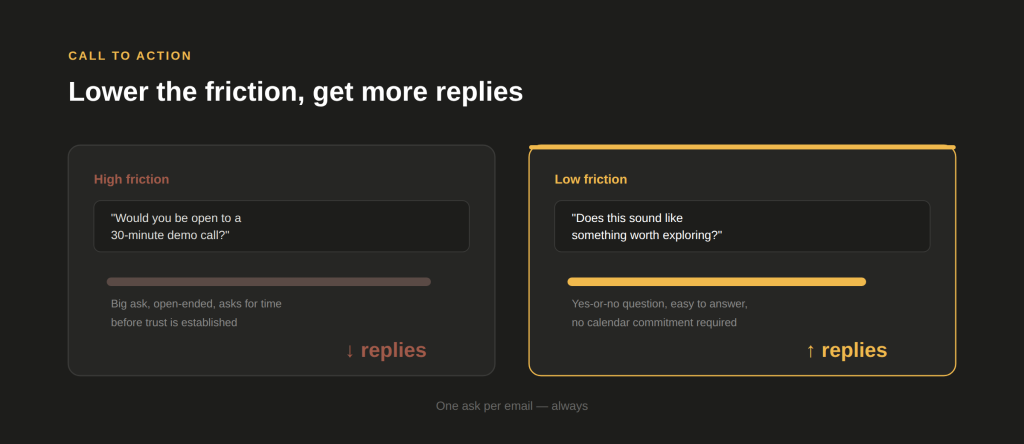
A low-friction call to action removes the effort of saying yes.
Instead of “Would you be open to a 30-minute demo call?”, try:
“Would it be worth a quick 10-minute call to see if this is relevant for you?”
Or even simpler: “Does this sound like something worth exploring?”
A yes-or-no question is easier to answer than an open-ended one. Lower friction means more replies, even from prospects who are mildly interested rather than highly motivated.
One ask per email. Always.
FAQ
There is no perfect length, but most high-performing cold emails sit between 75 and 150 words. The goal is to communicate value and prompt a response, not to explain everything. If your email needs more than 200 words to make the point, the message is probably not focused enough.
The best subject line is one that feels relevant and personal to the recipient. Short, specific lines tend to outperform clever or mysterious ones in B2B cold outreach. Avoid anything that looks like a newsletter header or promotional copy.
Most replies in cold email campaigns come from the second or third touch, not the first. A sequence of three to five emails spaced several days apart is a reasonable starting point. Each follow-up should add a new angle or piece of value, not just ask “Did you see my last email?” Timing matters here too — the science of timing for maximum cold email replies covers how send windows interact with your follow-up cadence.
Low reply rates usually come from one of three problems: a weak or irrelevant list, a subject line that does not get opened, or a message that does not give the prospect a clear reason to respond. Audit each element separately before assuming the whole approach is broken. For a sense of what benchmarks actually look like across channels, see 7 outbound metrics that actually matter.
Conclusion
Writing a cold email that earns a reply comes down to one thing: making it easy for the right person to say yes. That means being specific about why you are reaching out, framing your value around their problem, and ending with a simple, low-friction ask.
Cold email copywriting is a skill that improves with testing. Start with a clear structure, measure what is working, and iterate from there. If you would rather have a team of specialists run your outbound for you, that is exactly what Outbound Republic’s cold email service does. Reach out to learn how we build and manage cold email systems that deliver qualified meetings, without the guesswork.