
A cold email sequence that gets a respectable reply rate from marketing directors or operations managers can fall flat, or provoke outright hostile replies, when the same structure lands in an engineer’s inbox. This is not bad luck or a badly timed send. It is a mismatch between the classic cold email formula and how technical buyers actually evaluate and filter messages. Understanding the mismatch is the first step to fixing it.
Why Classic Cold Email Fails With This Audience
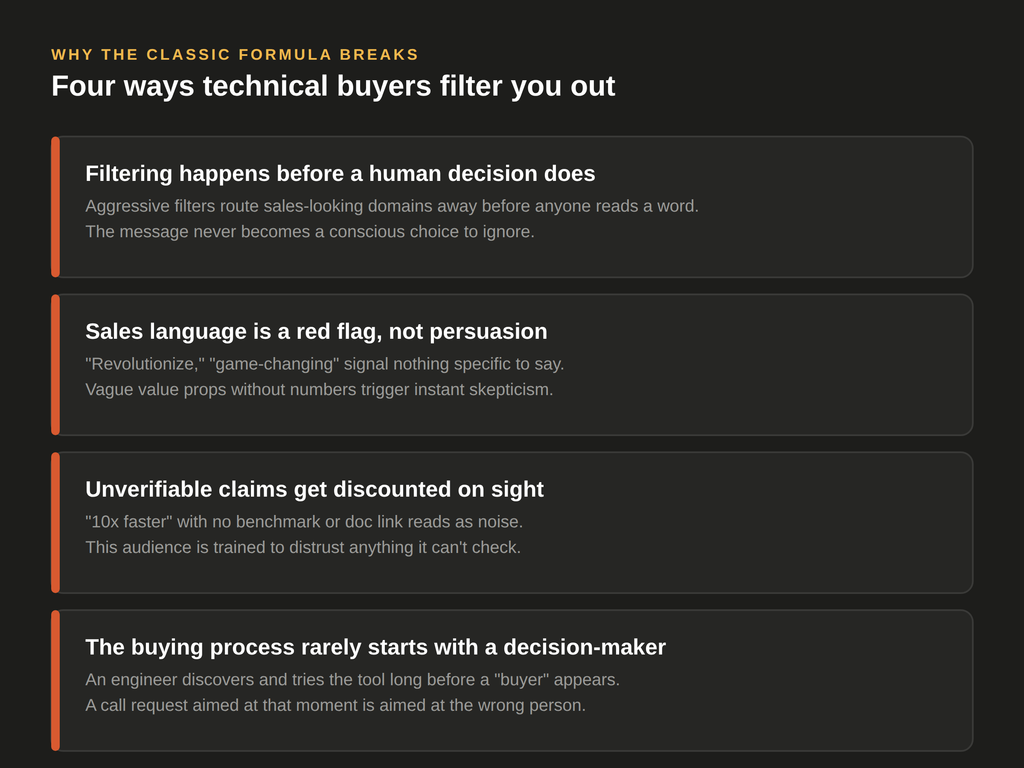
Filtering happens before a human decision does
Many engineers and DevOps professionals set up aggressive filters, route sales-looking domains straight to a folder they never check, or simply do not use the inbox that receives the outreach as their primary channel. A message can be well written and still never reach a moment where a person consciously chooses to ignore it, because it never gets read as a human decision at all.
Sales language is an immediate red flag, not persuasive copy
Words like “revolutionize,” “game-changing,” or “synergy” do not sound aspirational to a technical reader. They read as a signal that the sender has nothing specific to say and is filling space with marketing language instead. Vague value props without numbers or mechanism trigger the same reaction.
Claims without a way to verify them get discounted on sight
A developer’s default posture toward an unverified claim is skepticism. A statement like “our platform is 10x faster” without a benchmark, a doc link, or something checkable reads as noise, not evidence. This audience is trained by their own profession to distrust anything that cannot be checked.
The buying process usually does not start with a decision-maker conversation
In a lot of DevOps and infrastructure purchases, an individual engineer discovers a tool, tries it hands-on, and becomes an internal advocate long before anyone labeled a “buyer” enters the picture. A cold email written for a classic executive buying journey, built around booking a call with a decision maker, is often aimed at the wrong moment in a process that has already started somewhere else.
The generic call request reads as low effort
“Do you have 15 minutes this week?” with no specific reason tied to the recipient’s actual environment signals a sales tactic, not a genuine exchange of value. This audience has seen the template enough times to recognize it instantly.
What Actually Works Instead
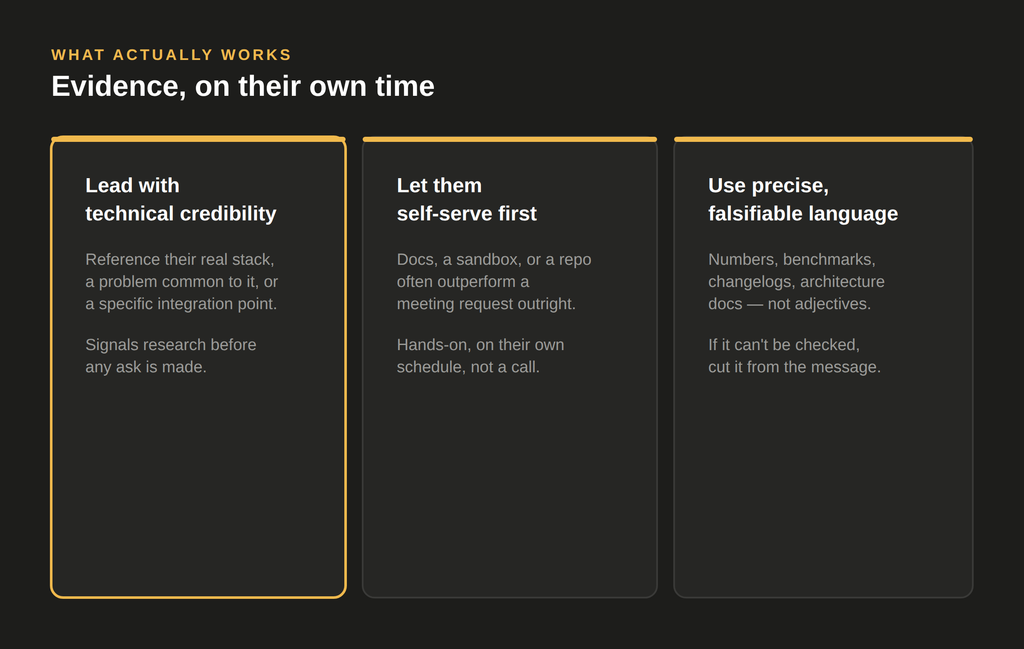
Lead with something technically credible, not a pitch
Reference something specific and verifiable about their environment: a stack visible through job postings or public engineering blogs, a real technical problem common to companies running their setup, or a specific compatibility or integration point. This signals research and relevance before any ask is made — the same signal-based approach to personalization that works across other B2B segments, just anchored to technical signals instead of firmographic ones.
Let them self-serve before asking for a call
A link to documentation, a sandbox environment, a GitHub repository, or a concrete technical resource often outperforms a meeting request outright. “Here’s how it works, try it yourself” respects how this audience actually prefers to evaluate a new tool, which is hands-on and on their own schedule, not through a scheduled conversation with a stranger.
Use precise, falsifiable language
Specific numbers, specific technical claims, and links to real evidence, a benchmark, a changelog, an architecture doc, replace adjectives that cannot be checked. If a claim cannot be backed by something the recipient could go verify themselves, it is worth cutting from the message entirely.
Treat email as reinforcement, not the whole strategy
Community channels, technical Slack or Discord communities, GitHub activity, developer-focused content, often do more groundwork with this audience than cold email running on its own. A cold email that lands after some other technical touchpoint, rather than as the very first contact, starts from a different baseline of familiarity.
Respect their time structurally, not just tonally
Shorter messages, no personalization filler included purely to look personalized, and a low-friction ask, a doc link rather than a scheduling request, tend to outperform longer templates that still read as generic once the underlying sales structure becomes visible.
Send from or reference a technical voice
Outreach that comes from, or clearly references, an actual engineer or technical founder changes how a first message is received compared to one from a generic sales title. Technical credibility on the sending side lowers the guard this audience puts up by default.
The Buying Committee Looks Different Here
In many DevOps and infrastructure sales, the technical evaluator and the economic buyer are different people operating on entirely different timelines. The technical champion typically needs to be won over first, often long before procurement or a budget holder is even aware a purchase is being considered. The same underlying pattern shows up across other technical, industry-specific sales, where the person reading a cold email is rarely the same person who ultimately signs off on it — a dynamic we have written about more broadly in why niche domain expertise can kill your outbound campaign and in outbound in niche B2B markets. The specifics differ by vertical, but the principle holds: know which role you are actually writing to, and do not assume the person reading your email is the one who says yes.
A Quick Before and After
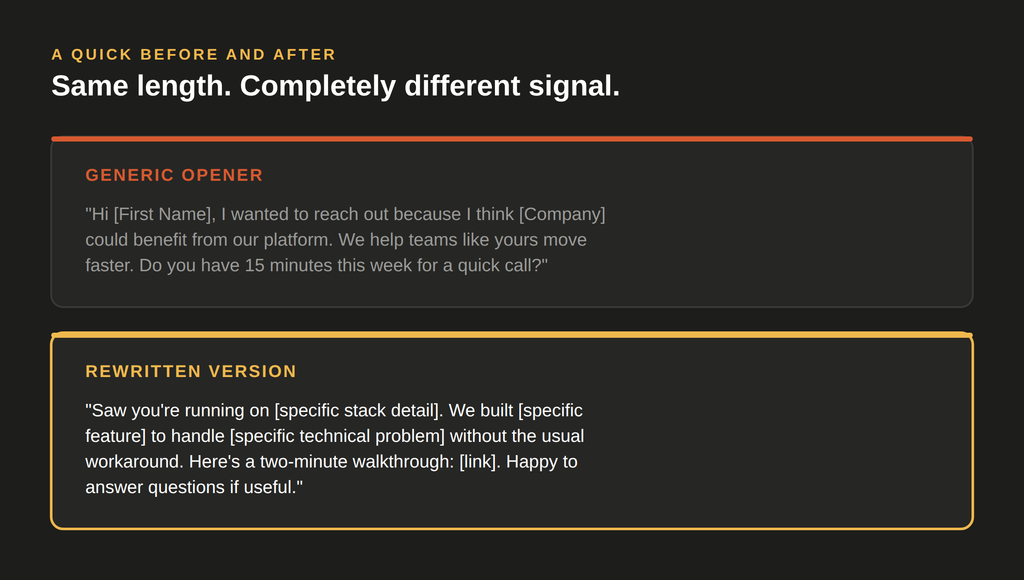
A generic opener: “Hi [First Name], I wanted to reach out because I think [Company] could benefit from our platform. We help teams like yours move faster and reduce complexity. Do you have 15 minutes this week for a quick call?”
A rewritten version: “Saw you’re running on [specific stack detail]. We built [specific feature] to handle [specific technical problem common to that stack] without the usual workaround of [specific pain point]. Here’s a two-minute walkthrough if you want to see how it works: [link]. Happy to answer questions if useful.”
The second version is not longer or more clever. It replaces vague claims with something specific and checkable, and it replaces the call request with something the recipient can evaluate on their own terms.
FAQ
Mostly because of what happens before a reply is even possible. Aggressive inbox filtering, a trained skepticism toward unverifiable claims, and a buying process that often starts with an individual engineer rather than a decision-maker all reduce the odds that a classic sales email is read as a genuine, checkable offer.
Usually the technical evaluator, not the economic buyer, since that person typically discovers and validates the tool long before a budget holder is involved. Finding that message-market fit for a technical audience means writing to the person doing the hands-on evaluation, not the title with sign-off authority.
The Underlying Fix Is Structural, Not Stylistic
This is not about writing cooler copy for developers. The entire classic cold email formula, interrupt with a claim, pitch a benefit, ask for a call, assumes a buying behavior this audience largely does not follow. Fixing it means changing what the message asks for and what it offers as proof, not just polishing the tone. Teams that make this shift tend to see the hostility and silence that generic outreach produces with this audience replaced with something much closer to how a technical buyer actually wants to be approached: with evidence, on their own time, with a way to verify the claim themselves.
If your outbound is built for a generic buyer and you are trying to reach a technical one, it is worth rebuilding the sequence around this audience specifically rather than softening the same template. That is exactly the kind of vertical-specific work we do for software companies — get in touch if you want a second look at how your current sequence reads to a technical inbox.