
There is a version of outbound that works beautifully. You define your ICP, write sharp copy, sequence it well, and meetings start landing on the calendar. That version exists. But it relies on one assumption that often breaks down: that the person writing the emails actually understands the world the buyer lives in.
In highly specialized industries, that assumption fails more often than people expect. The gap between a skilled outbound team and a deeply technical market is not a copywriting problem. It is a credibility problem. And if it goes unaddressed, it does not just produce low reply rates. It can actively damage the brand you have spent years building. This is the same ground we cover more broadly in outbound in niche B2B markets and why industry context changes everything – this article goes one level deeper, into the specific mechanics of closing that knowledge gap with an outside team.
This article looks at why domain knowledge is such a critical variable in B2B cold outreach, what the hidden costs of the knowledge transfer process look like, and how to decide whether outsourcing outbound actually makes sense for your specific situation.
Why Generic Messaging Fails in High-Specialization Markets
Most outbound frameworks are built for broad markets. They teach you to identify pain points, write punchy subject lines, and personalize at scale. That approach works reasonably well when your buyers are, say, HR managers or e-commerce founders. The language is familiar. The pain points are well-documented. The bar for credibility in a cold email is relatively low.
Niche markets are different. When you are reaching out to, for example, a procurement director at a pharmaceutical company, or a technical lead at an industrial hardware firm, the bar is much higher. These buyers can spot generic messaging immediately. If your email does not reflect a genuine understanding of their world, including their terminology, their regulatory environment, their operational pressures, it reads as noise. We see this play out concretely in manufacturing, where outbound built for manufacturing and production companies has to speak in terms of lead times, supplier qualification, and production continuity — not generic “synergies and scalable solutions” language that a VP of Operations will immediately discount.
The problem is not that cold outreach cannot work in these markets. It is that it requires a level of domain fluency that takes time to build.
A few things tend to go wrong:
- Copy feels too direct or too casual for the industry’s communication norms
- Pain points are described in general terms instead of specific, recognizable language
- The offer sounds like it was written for a SaaS startup, not a specialist firm
- The outreach inadvertently signals that the sender does not really know the space
That last point is the most damaging. In markets where companies compete on expertise and reputation, an email that feels uninformed does not just get ignored. It can leave a negative impression with exactly the buyers you most want to reach.
The Hidden Cost of the Knowledge Transfer Process
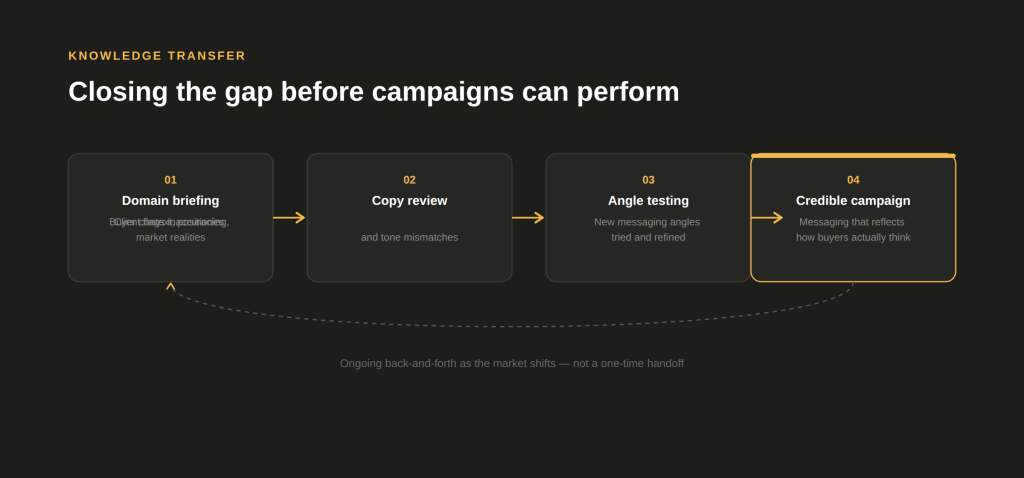
When a company in a specialized field hires an outbound agency, there is a knowledge gap that needs to be closed before the campaign can perform. This is expected and manageable. What often gets underestimated is how much time and energy the transfer process actually takes.
Effective knowledge transfer in outbound in niche industries typically requires:
- Detailed onboarding sessions where the client explains their buyer, their competitive positioning, and their market context
- Multiple rounds of copy review where the client flags inaccuracies or tone mismatches
- Ongoing back-and-forth as new messaging angles are tested and refined
- Domain briefings that go beyond surface-level product knowledge into the nuances of how buyers actually think
This is the same discipline behind finding message-market fit for outbound — a thorough onboarding process that captures far more than basic company information is what turns a generic campaign into one that actually reflects the client’s market.
This back-and-forth is not a sign that something is wrong. It is a structural feature of working in complex markets. But it does mean that the client’s time investment in managing an outbound agency is higher than it would be in a generic B2B market. If that investment is not budgeted for, it creates friction, delays, and frustration on both sides.
The outbound agency knowledge gap becomes particularly costly when:
- The client’s internal team is already stretched thin
- The market has very specific cultural or regional communication norms (European markets, for example, often require a more formal, measured tone than US-style outreach)
- The brand has strong existing positioning that could be undermined by low-quality or off-brand outreach
That last scenario is worth pausing on. Some companies have spent years building a reputation as the best in their field. For them, a poorly calibrated cold email campaign is not a neutral event. It is a reputational risk. The potential damage from outreach that misrepresents the brand can outweigh the potential gain from the leads it generates.
How Agencies Can Bridge the Gap
The knowledge gap is a real challenge, but it is not an argument against outsourcing outbound altogether. It is an argument for doing the onboarding process properly. Agencies that work well in specialized B2B markets tend to follow a few practices that others skip.
Structured Onboarding with Domain Briefings
Rather than a single kickoff call, effective onboarding in niche markets involves multiple sessions focused on different dimensions of the buyer’s world. This includes the buyer’s language, the problems they face that are specific to their industry, the competitive dynamics of the market, and the communication norms that shape how outreach is likely to land. Our own approach to this is detailed in how to find message-market fit for B2B outbound at scale, which covers what a genuinely useful onboarding conversation needs to capture beyond the basics.
Iterative Copy Review with Expert Input
Copy should not go out without review from someone with domain knowledge. That might be someone from the client’s team, or it might be an external domain expert who can validate whether the messaging reflects how practitioners in the field actually think and communicate. Skipping this step to move faster is almost always a false economy in specialized markets.
Regional and Cultural Calibration
Outreach that works in North America does not always translate to European markets. Buyers in Germany, France, or the UK often expect a more formal, considered approach. What reads as confident and direct in a US context can read as aggressive or presumptuous in other markets. Agencies that recognize this calibrate their copy accordingly.
Setting Honest Expectations on Timeline
Outbound in niche industries takes longer to optimize than in broader markets. There are fewer prospects in the total addressable market, the feedback loops are slower, and it takes more iterations to find messaging that resonates. Campaigns that are judged too quickly, before the knowledge transfer has fully happened, often get cancelled before they have had a real chance to work. Our guide to why outbound takes time and setting realistic expectations for your first 90 days covers what a fair timeline actually looks like — niche markets typically sit at the longer end of that range.
When In-House Outbound Makes More Sense
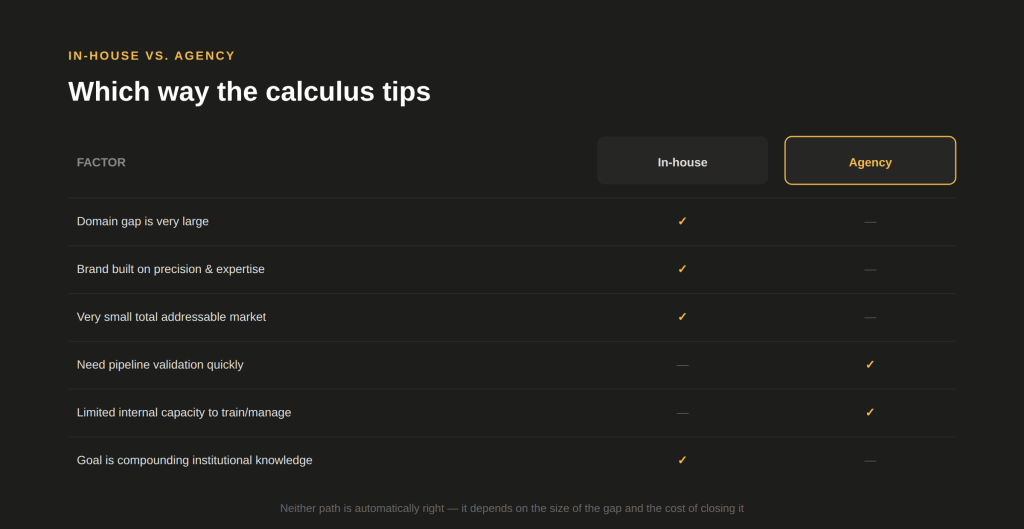
For some companies, the calculus genuinely points toward building an in-house SDR function rather than outsourcing. This is not always the wrong decision. It is worth thinking through the tradeoffs honestly.
In-house outbound tends to make more sense when:
- The domain knowledge gap is very large and the knowledge transfer cost would be prohibitive. If it takes six months to teach an external team enough to write credible outreach, a dedicated in-house hire who grows into the role might be a better long-term investment.
- The brand’s positioning is built around expertise and precision. Companies where every piece of external communication needs to be verified by a domain expert before going out may find that the review overhead of an agency relationship is difficult to sustain.
- The market is very small. In a niche with only a few hundred qualified prospects globally, high-volume outbound is less relevant. What matters is relationship quality, and that is often better served by someone who is deeply embedded in the company and its market. This is also exactly the scenario where a smaller, more deliberate GTM market validation approach tends to outperform volume-driven outbound.
- The goal is to build institutional knowledge. An in-house SDR who works closely with the sales and technical teams over time builds expertise that compounds. An agency relationship, by contrast, carries the risk that knowledge walks out the door if the engagement ends.
The flip side is also true. In-house SDRs take three to six months to ramp, require management overhead, and carry real cost even if they underperform. For companies that need pipeline validation quickly, or that do not yet have the internal capacity to train and manage an SDR, an agency with a rigorous onboarding process can still be the faster and lower-risk path.
FAQ
It usually fails because the messaging lacks domain credibility. Buyers in technical or highly specialized markets can quickly tell when an email was written by someone who does not understand their world. Generic pain points, unfamiliar terminology, and a tone that does not match industry norms all reduce response rates and can damage brand perception.
The knowledge gap refers to the difference between what an outbound agency knows about a client’s market and what they need to know to write credible, effective outreach. It is fixed through structured onboarding, detailed domain briefings, iterative copy review with subject matter experts, and an honest timeline that accounts for the learning curve.
It can be, but it requires more upfront investment in the knowledge transfer process and a longer runway before results come in. For companies with small total addressable markets or strong brand positioning built on expertise, the risks of low-quality outreach are higher and need to be managed carefully.
In-house outbound makes more sense when the knowledge transfer cost is very high, when the brand’s reputation depends on precise, expert-verified communication, or when the company wants to build institutional sales knowledge over time. It is also worth considering when the total addressable market is small enough that relationship quality matters more than volume.
Conclusion
Running outbound in niche industries is not simply a matter of writing better copy or using better tools. It requires real domain fluency, and building that fluency between an agency and a technical client takes time and deliberate effort. The back-and-forth knowledge transfer process is a real cost that needs to be planned for, not minimized.
For companies with strong brand positioning, the stakes of getting the outreach wrong are especially high. A campaign that feels off-brand or uninformed can do more damage than no campaign at all.
If you are evaluating whether to outsource your outbound or build in-house, the right answer depends on how large the knowledge gap is, how much your brand depends on communication quality, and how much internal capacity you have to support the process. Getting that assessment right from the start is what separates campaigns that generate pipeline from ones that quietly erode the credibility you have built. If you want to talk through where your market falls on that spectrum, get in touch — we’re happy to give you a straight answer, even if it’s not “hire us.”