
Cold calling gets declared dead roughly once a year, and it keeps not dying. What has actually changed is not whether the phone works, but what job it does inside a sequence. Used as a standalone channel the way it was fifteen years ago, cold calling performs poorly against almost any modern benchmark. Used as one coordinated part of a multi-channel sequence, it often does something email and LinkedIn cannot do on their own: create a real-time, two-way conversation at the exact moment a prospect is paying attention. That distinction is really about the same psychology that makes any cold outreach land or fall flat – familiarity and relevance change how a message is received, and the phone is no exception to that rule.
This post looks at where phone outreach actually earns its place in a 2026 outbound stack, and where teams are wasting time treating it as a channel of last resort instead of a deliberate tool.
Why Cold Calling Alone Underperforms
The case against pure cold calling is not new, and it still holds up. Connect rates on cold dials to B2B decision makers are low, most calls that do connect end in a polite decline within the first fifteen seconds, and the volume required to generate a meaningful number of conversations is difficult to sustain without a dedicated team doing nothing else. For context, cold call connect rates typically land in the 8-12% range, well below what a warm, contextual LinkedIn message achieves – a gap that says less about the phone as a medium and more about what happens when it has no supporting context.
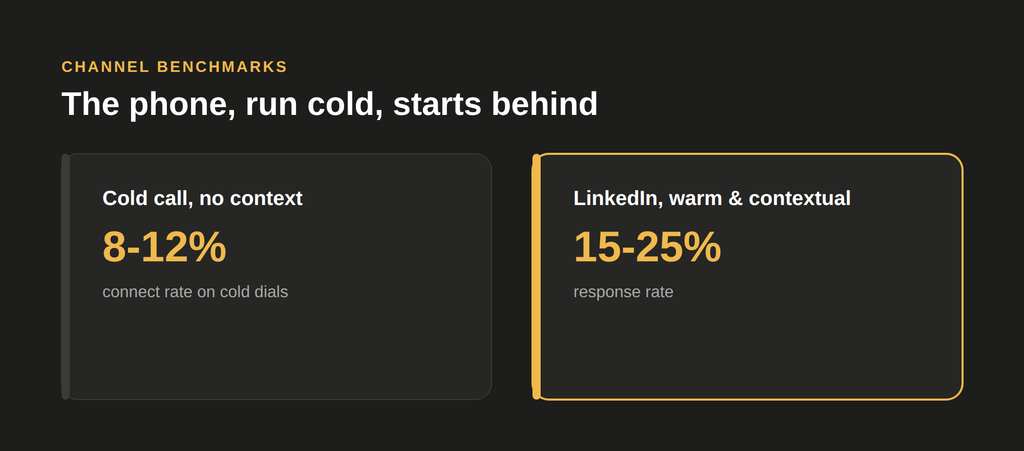
None of that means the phone itself is broken. It means calling cold, with no prior touchpoint and no context, forces the call to do all the work of introduction, qualification, and persuasion in a single unscheduled interruption. That is a hard job for any channel.
Why the Phone Works Differently Inside a Sequence
The picture changes when a call is not the first touch, but a scheduled step after email and LinkedIn have already done some of the groundwork. A prospect who has seen your name in an inbox and a connection request before the phone rings is answering a call from someone vaguely familiar, not a total stranger. That single difference changes the tone of the conversation from the first sentence.
A few patterns show up consistently in sequences that use the phone well:
Calls work best as a response to a signal, not a blind touch. A call placed right after a prospect opens an email multiple times, views a LinkedIn profile, or engages with a post performs meaningfully better than a call placed on a fixed day regardless of any signal. This requires the email and LinkedIn steps to actually feed information back into when calls get made, rather than running the phone step on a rigid schedule disconnected from the rest of the sequence. It’s the same logic behind weaving real buying signals into cold email instead of relying on static firmographic data – a call is just another channel that gets sharper when it’s triggered by something real rather than a calendar date.
The call earns the right to be direct because the other channels already introduced the idea. A cold call opening with a full pitch tends to trigger an immediate decline. A call that references a specific email already sent, or a specific point already raised on LinkedIn, gives the prospect a reason to stay on the line past the first ten seconds, because it does not feel like a random interruption.
Voicemail becomes part of the message sequence, not a fallback. A short, specific voicemail that references the same context as the email, rather than a generic “just following up,” functions less like a missed call and more like an additional touchpoint that increases the odds of a reply to the next email.
LinkedIn’s Role in the Same Sequence
LinkedIn tends to work best as the layer that builds familiarity before either email or a call asks for anything. A connection request or light engagement, such as commenting on a relevant post, before outreach begins gives the prospect a visual point of recognition later, whether that is an email landing in their inbox or a name showing up on caller ID through a saved contact or a quick search. This is the same role LinkedIn plays even in a two-channel sequence without a phone step at all – familiarity first, direct asks later, regardless of how many channels are involved.
The mistake worth avoiding is treating LinkedIn as an identical copy of the email sequence, just on a different platform. Messages that read as an obvious duplicate of the same pitch sent everywhere tend to get the same flat response across every channel. LinkedIn works better as a lighter-touch, more conversational layer, reserving direct asks for email and calls once some familiarity already exists.
What a Coordinated Sequence Actually Looks Like
A pattern that tends to outperform any single channel run in isolation looks roughly like this:
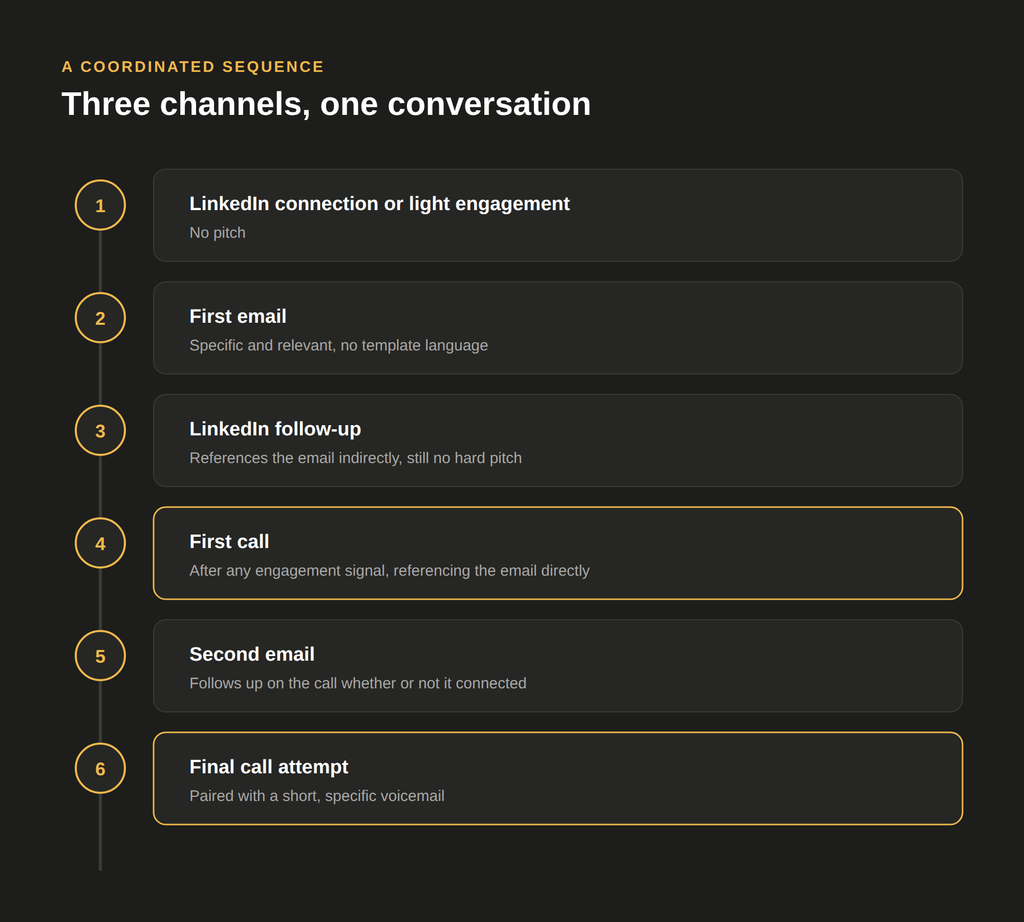
- LinkedIn connection request or light engagement, no pitch
- First email, specific and relevant, no generic template language
- LinkedIn follow-up referencing the email indirectly, still no hard pitch
- First call, placed after any engagement signal from steps one through three, referencing the email directly
- Second email, following up on the call whether or not it connected
- Final call attempt, paired with a short, specific voicemail
The exact order and timing should flex based on the prospect’s sales cycle and seniority, but the underlying principle stays the same: each channel references what came before it, rather than running as three disconnected outreach attempts that happen to target the same person. If you’re starting from a two-channel base, the same day-by-day structure used for an email and LinkedIn sequence extends naturally once you add calls as a third, signal-triggered layer rather than a parallel track.
When Cold Calling Is Worth the Investment, and When It Is Not
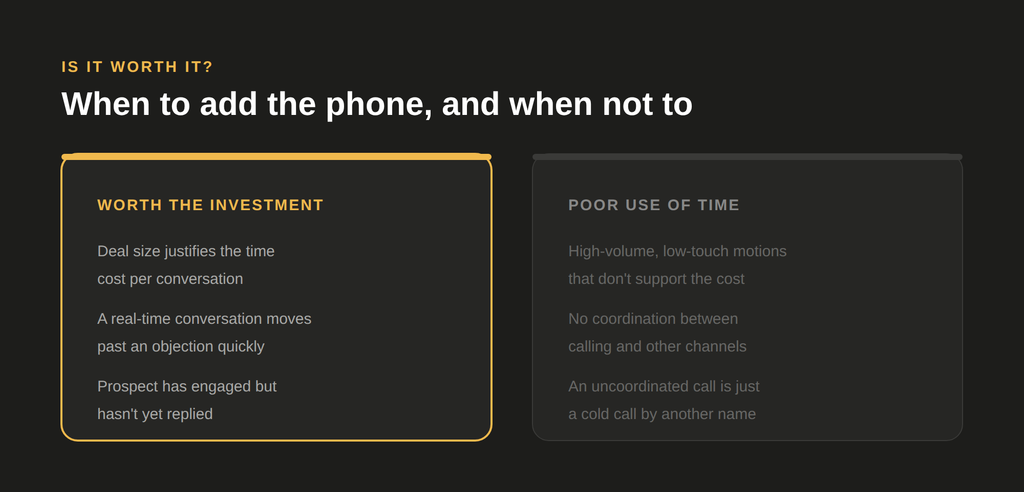
Phone outreach is not equally valuable across every type of outbound motion. It tends to earn its place when deal sizes are large enough to justify the time cost per conversation, when the buying process benefits from a real-time conversation to move past an objection quickly, or when a prospect has clearly engaged with earlier touches but has not yet replied.
It tends to be a poor use of time in high-volume, low-touch motions where the economics do not support the time cost of dialing, or in sequences where there is no coordination between calling and the other channels, since an uncoordinated call is close to a cold call in every sense that matters, phone number aside.
The Real Question for 2026
The question worth asking is not whether cold calling still works in the abstract. It is whether your calling step is actually connected to the rest of your sequence, informed by engagement signals, and given context from prior touches, or whether it is running on autopilot as a leftover step from an older playbook. The teams still getting real value from the phone in 2026 are almost never running it in isolation. They are running it as one coordinated part of a sequence where every channel makes the next one work a little better.
If you’re weighing whether to add calling into your own outbound stack, or want a second opinion on whether your current sequence actually coordinates its channels, get in touch – we build and run multi-channel outbound for a living, phone included.