

Most outbound agency sales calls sound remarkably similar. Everyone claims a proven process. Everyone says they use AI. Everyone promises a dedicated account manager. If you are currently comparing agencies, you have probably noticed that the pitches blur together after the third or fourth call. That’s worth pausing on before you even get to a checklist – the in-house versus agency decision itself shapes which of these questions matter most to you.
This checklist exists to give you a way to tell agencies apart on substance instead of pitch quality. Some of these questions are uncomfortable to ask. Ask them anyway. How an agency responds tells you more than the answer itself.
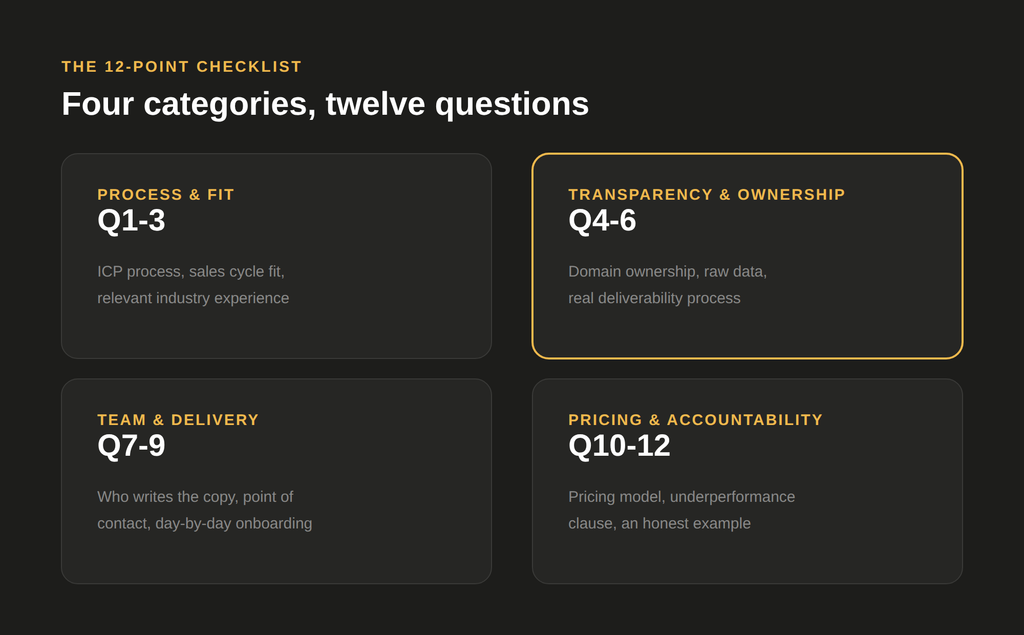
Process and Fit
1. Can they clearly explain their ICP building process, not just their outreach process?
Plenty of agencies can describe how they write emails and run sequences. Fewer can walk you through how they actually define and validate an ideal customer profile before writing a single line of copy. If the answer jumps straight to messaging and channels, that is a signal the targeting work is thin. This is also exactly the information you should be prepared to hand them yourself before kickoff — an agency that never asks for it is a red flag in either direction.
2. Do they ask about your sales cycle length and buying committee before pitching a package?
An agency that quotes you a standard package in the first call, before understanding whether you sell a fast, single decision maker product or a slow, multi stakeholder enterprise deal, is selling a template. Sales cycle and buying committee complexity should shape the entire approach, not just the messaging.
3. Have they worked in your industry or a comparably complex one, and can they name specifics?
A logo on a website is not proof of relevant experience. Ask for specifics: what was the ICP, what channel mix worked, what did not work initially. An agency that has actually done the work in your space or something close to it will answer in concrete detail, not generalities.
Transparency and Data Ownership
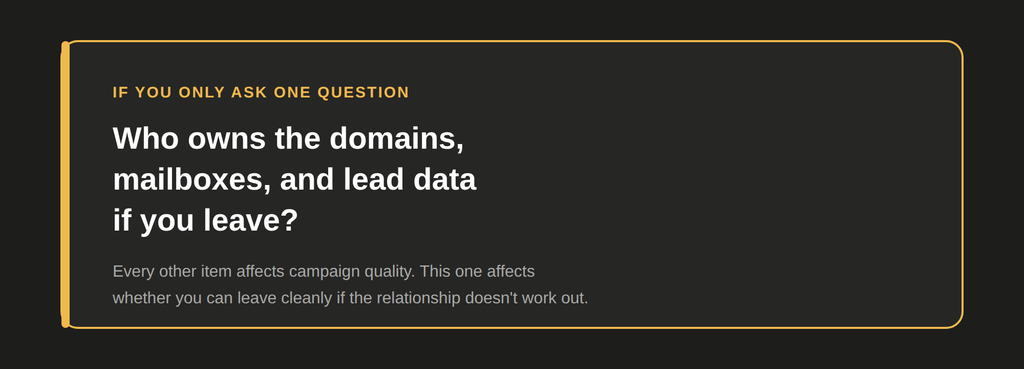
4. Who owns the domains, mailboxes, and lead data if you leave?
This is the single most important, most overlooked question on this checklist, and it deserves more attention than any other item here. Some agencies build campaigns on domains and mailboxes they control, which means if you switch providers, you lose your sending infrastructure and reputation along with them. Others hand over full ownership from day one. Get a clear, specific answer in writing before you sign anything. This one question has caused more painful agency transitions than any other factor on this list. It’s worth understanding why a dedicated sending domain matters in the first place before you ask who controls it.
5. Will they share raw campaign data, or only curated dashboards?
Polished weekly dashboards look great in a client meeting, but they can also hide underperformance. Ask whether you can see raw sending data, reply rates by segment, and actual message content, not just summary metrics chosen by the agency.
6. What is their deliverability and warm up process, and will they explain it, not just claim results?
Deliverability is the foundation everything else depends on. An agency that can only say “we have great deliverability” without explaining warm up schedules, sending limits, or how they monitor domain health has not actually built a process. It has a talking point. If they can’t walk you through why skipping warm-up quietly kills deliverability in their own words, that’s worth noting.
Team and Delivery Model
7. Who is actually writing your copy: a senior strategist, a junior account manager, or an AI tool with no review step?
This question matters more now than it did a few years ago, since AI generated copy has become common across the industry. There is nothing wrong with using AI to draft outreach. There is a real problem if there is no human review step before messages reach your prospects. We wrote about why that review layer matters in quality assurance in AI powered outbound, and it is worth asking any agency you are evaluating the same question directly.
8. Is there a dedicated point of contact, or a rotating pool?
Account continuity affects both quality and speed. If your point of contact changes every few months, expect ramp up time and lost context each time it happens.
9. What does the first 30, 60, and 90 days actually look like, day by day, not just at a milestone level?
A vague answer here, such as “we start slow and ramp up,” is not enough. You want specifics: when does list building start, when does the first campaign send, when do you see the first performance review. For a full breakdown of what a well run onboarding period looks like, see your first 90 days with an outbound agency.
Pricing and Accountability
10. Is pricing retainer, pay per lead, or hybrid, and what exactly counts as a qualified lead in the contract?
The pricing model matters less than the definition behind it. “Qualified lead” means different things to different agencies, and a vague definition in the contract is where disputes start later. Sales and marketing teams often disagree on this exact point even internally, so it’s worth getting the exact criteria in writing rather than assuming everyone means the same thing.
11. What happens if results fall below target for two consecutive months: a walk away clause, a pause, a refund, or nothing?
Ask this directly before you sign. An agency confident in its process will have a clear answer. An agency that gets vague or defensive here is telling you something important about how they handle underperformance.
12. Can they show you a real example of a campaign that underperformed and what they changed?
A highlight reel of wins tells you almost nothing about how an agency actually operates. Ask for an honest example of something that did not work initially and how they diagnosed and fixed it. Agencies that can answer this comfortably tend to be the ones with an actual process, not just a case study library.
The One Question to Ask If You Only Ask One
If you have time for only a single question in a sales call, ask about domain and data ownership. It is the item most often glossed over in a pitch, and the one that causes the most damage after the fact if it goes unanswered. Everything else on this list affects the quality of your campaigns. This one affects whether you can even leave cleanly if the relationship does not work out.
Red Flags That Do Not Need a Full Checklist Item
A few warning signs are worth flagging even though they did not make the main 12:
- Guaranteed meeting numbers with no context about ICP, market, or industry benchmarks
- Refusal to share references or connect you with a current client
- No clear answer on whether execution is subcontracted or outsourced
- Pressure to sign on the same call as the pitch
None of these alone is disqualifying, but more than one together is a reasonable reason to keep looking.
Final Thought
The agencies that hesitate on the transparency questions, data ownership, underperformance handling, and who is actually doing the work, are giving you the most useful signal in the entire evaluation process. A good agency should welcome a checklist like this one, not deflect it. If you get vague or defensive answers to more than two or three of these questions, treat that as data, not bad luck.
If you’d like to put us through this exact checklist, get in touch — we’d rather answer all twelve on a call than have you find out the hard way six months in.
Related: Your First 90 Days With an Outbound Agency, Quality Assurance in AI Powered Outbound