

Most outbound playbooks for manufacturing default to the same target: the owner, the CEO, the VP of Operations. It makes sense on paper. These are the people with budget authority and the final signature. It also explains why so many campaigns into manufacturing stall out after a promising first reply.
The problem is that in most manufacturing companies, procurement is not a rubber stamp at the end of the process. It is an active gatekeeper with its own evaluation criteria, its own timeline, and often its own veto power long before anything reaches leadership for a signature. Ignore that layer, and you are optimizing your entire outbound motion for the wrong audience.
Why Manufacturing Buying Committees Look Different
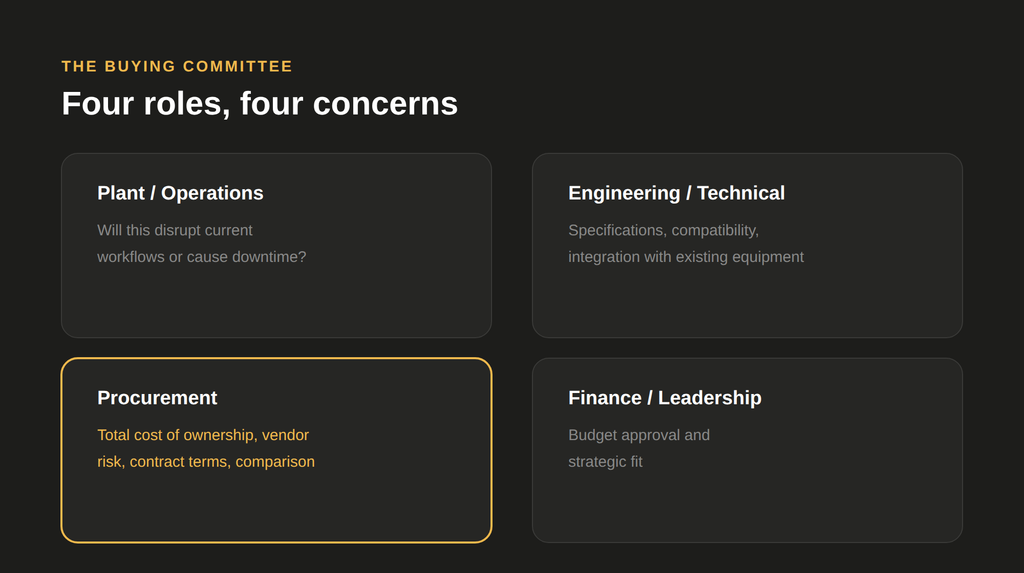
In many B2B categories, the economic buyer and the evaluator are close enough to the same person that a simplified outbound approach still works. Manufacturing rarely works that way. A typical evaluation for anything beyond a small purchase involves several distinct roles, each with a different concern:
- Plant or operations managers, focused on whether a solution disrupts current workflows or downtime
- Engineering or technical leads, focused on specifications, compatibility, and integration with existing equipment
- Procurement, focused on total cost of ownership, vendor risk, contract terms, and comparison against alternatives
- Finance or leadership, focused on budget approval and strategic fit
An email that only speaks to strategic fit and business impact, the language that resonates with leadership, often reads as vague or irrelevant to procurement, whose job is specifically to scrutinize the details leadership does not have time for. This is really a role and seniority segmentation problem – the same discipline that goes into mapping who actually signs off versus who just influences the decision applies just as much within a single target account as it does across your whole list.
What Procurement Actually Cares About
If your messaging has been built entirely around a leadership audience, it is worth rewriting a parallel version aimed specifically at procurement. The concerns are different enough that a single generic message rarely serves both well.
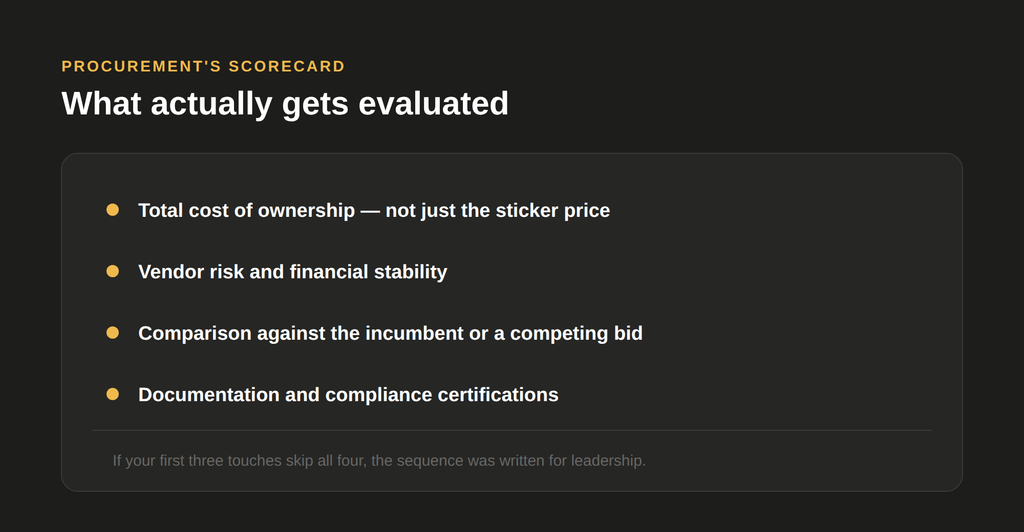
Procurement in manufacturing environments typically evaluates:
Total cost of ownership, not just price. Procurement teams are trained to look past the sticker price toward implementation cost, maintenance, training time, and switching cost down the line. A message that leads only with price positioning misses this entirely.
Vendor risk and stability. Manufacturing supply chains have been through enough disruption in recent years that procurement teams now routinely ask about vendor financial stability, business continuity, and single points of failure. This is worth addressing proactively rather than waiting for it to come up.
Comparison against existing vendors or incumbents. Procurement rarely evaluates in a vacuum. They are almost always comparing you against an incumbent supplier or a competing bid. Messaging that acknowledges this directly, rather than pretending you are the only option under consideration, tends to land better.
Documentation and compliance. Certifications, quality standards, and compliance documentation matter more in manufacturing procurement than in most other B2B categories. If your offering has relevant certifications, procurement wants to see them early, not after several calls.
How This Changes Your Outbound Sequence
Reaching procurement effectively usually means adjusting more than just word choice. A few structural changes make a real difference:
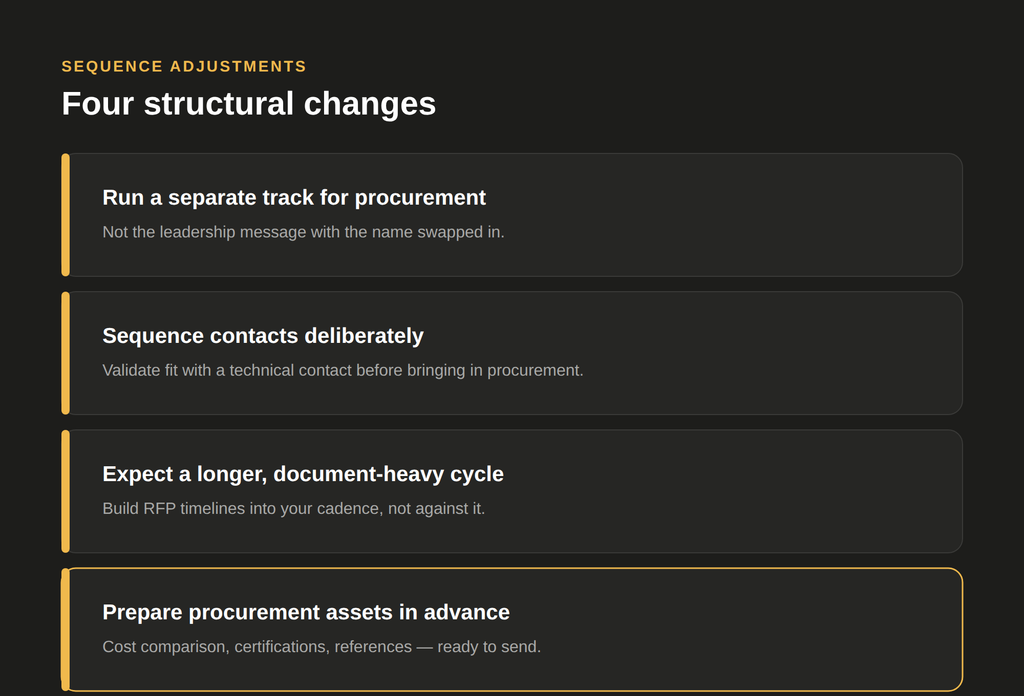
Run a separate track, not a single message to multiple titles. Sending the same sequence to a plant manager and a procurement lead, with only the name and company swapped in, produces exactly the generic feel that procurement is trained to filter out. Build a distinct message track for procurement that speaks directly to cost, risk, and comparison, rather than reusing your leadership-facing copy with minor edits. It’s the same logic behind tracking engagement at the person level instead of the company level — a procurement lead and a plant manager at the same account are two different conversations, not one lead with two names attached.
Sequence contacts deliberately, not simultaneously. In many manufacturing deals, the most effective sequencing starts with a technical or operational contact to validate fit, then brings procurement in once there is internal momentum, rather than blasting every role at once. Simultaneous outreach to multiple stakeholders who have not yet talked to each other internally can create confusion or duplicate effort on their end.
Expect a longer, more document-heavy cycle. Manufacturing procurement often requires formal documentation, sometimes an actual RFP process, even for deals that would move quickly in other industries. Building this expectation into your sequence cadence and follow up timing prevents the campaign from looking abandoned when in reality the buyer is just working through an internal process — a pattern consistent with why longer decision chains at larger accounts routinely take 60 to 90 days just to produce a qualified conversation. We have written more broadly about this pattern in why cold outbound struggles in long sales cycle industries, and manufacturing is one of the clearest examples of it in practice.
Prepare procurement-specific assets in advance. Having a one page cost comparison, a certifications summary, or a reference list ready to send the moment procurement engages saves cycles that would otherwise be spent going back and forth over email requesting basic documentation.
A Simple Test for Your Current Messaging
If you already have manufacturing campaigns running, a quick way to check whether you are actually reaching procurement effectively: pull up your current sequence and ask whether it mentions total cost of ownership, vendor risk, or comparison against alternatives anywhere in the first three touches. If the answer is no, the sequence was almost certainly written with leadership in mind, even if procurement contacts are technically on the list.
This matters more than it might seem, because a procurement contact who reads three leadership-oriented messages in a row tends to conclude, correctly, that the vendor does not understand how their evaluation process actually works. That impression is difficult to undo later in the cycle.
Where This Fits Into a Broader Manufacturing Strategy
Procurement is one piece of a larger pattern that shows up across manufacturing and other complex, technical B2B categories: generic outbound playbooks built for simpler, single stakeholder sales tend to underperform once real industry context enters the picture. We covered this more broadly in outbound in niche B2B markets, and manufacturing procurement is a specific, high value example of exactly why that context matters.
Getting the leadership message right is still necessary. It just is not sufficient on its own. The campaigns that actually convert in manufacturing tend to be the ones built with procurement in mind from the start, not as an afterthought once a deal is already stalling in evaluation.
If you’re building outbound into manufacturing and want a second pair of eyes on whether your sequence actually speaks to procurement, get in touch — it’s a quick thing to check and an expensive thing to get wrong. This is also the exact gap our outbound for manufacturing and production companies service is built to close, with messaging written for operational buyers from the first email, not retrofitted after a campaign stalls.
Related: Outbound in Niche B2B Markets, Why Cold Outbound Struggles in Long Sales Cycle Industries