

Most content about SDR teams focuses on what the individual rep should do: how to write better subject lines, how to handle objections, how to structure a call. That content matters, but it assumes the team around that SDR is already well built. In practice, a huge amount of SDR underperformance traces back to management decisions made before the rep ever sent their first email: how the team is structured, what gets measured, and how someone is brought up to speed in their first months on the job.
This is a guide for the person building or running that team, not the person executing inside it. It assumes you’ve already made the call to build in-house rather than outsource, if you haven’t, weighing that decision first is worth doing before you invest in structure, and if you land on the agency route instead, this checklist covers what to ask before signing.
Getting the Structure Right
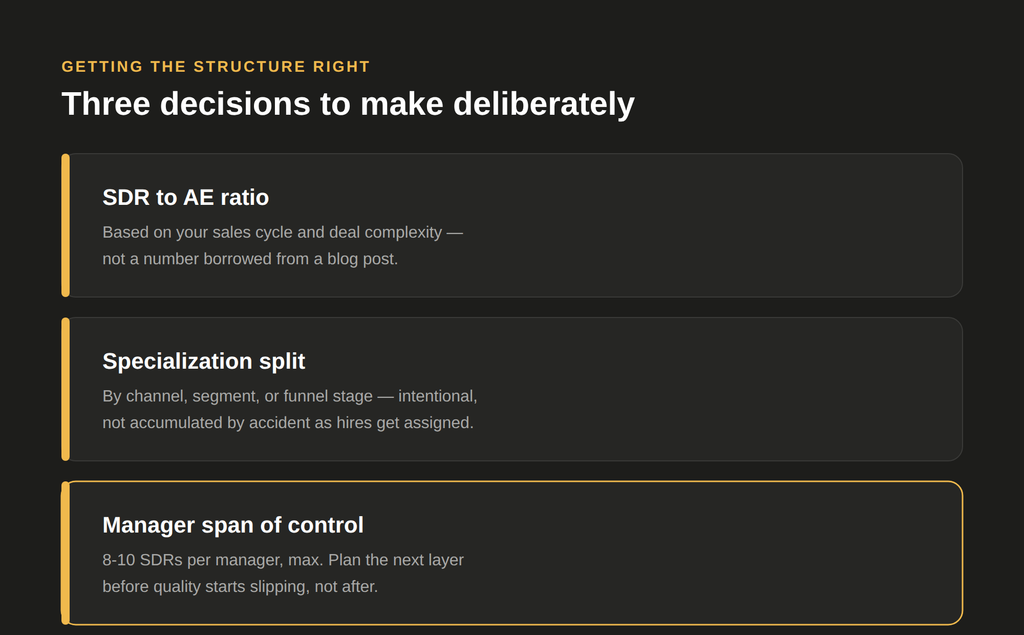
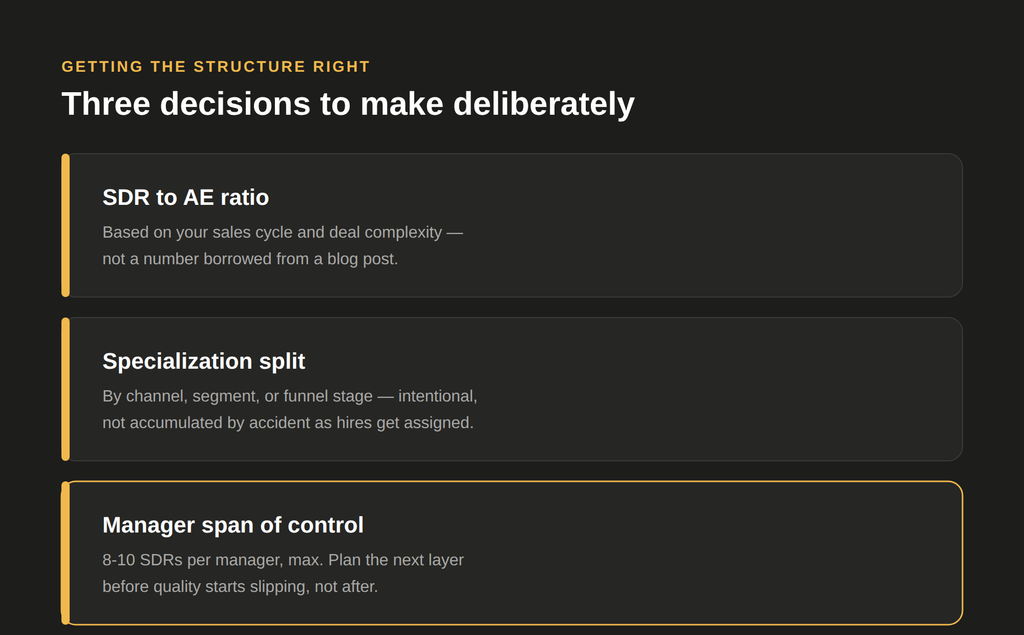
Decide the SDR to AE ratio deliberately, not by default. A common mistake is hiring SDRs and AEs in a fixed ratio inherited from a previous company or a generic benchmark, without checking whether it matches your actual sales cycle and deal complexity. A short cycle, high volume motion can often support one SDR feeding two or three AEs. A long, complex enterprise cycle sometimes needs the opposite, with SDRs spending enough time per account that the ratio flips. Set the ratio based on how much qualified pipeline one SDR can realistically generate for your specific sales motion, not a number borrowed from a blog post.
Decide whether SDRs specialize by channel, segment, or stage. Some teams split SDRs by outbound channel, one group on email and LinkedIn, another on calling. Others split by market segment, one team on enterprise accounts, another on mid market. Others split by funnel stage, one team purely on outbound prospecting, another on inbound follow up. There is no universally correct answer, but the split should be intentional and revisited as the team grows, rather than accumulated by accident as new hires get assigned wherever there is a gap.
Set a realistic span of control for managers. One manager overseeing more than eight to ten SDRs typically cannot give each rep meaningful call review, pipeline coaching, and 1:1 time on a regular basis. If the team is growing past that size, plan for a second manager or team lead layer before quality starts slipping, not after.
Choosing KPIs That Actually Predict Results
The most common mistake in SDR management is tracking activity metrics as if they were outcome metrics. Calls made and emails sent are useful diagnostic numbers, but they say nothing about whether the work is effective. A useful KPI framework separates the two clearly. It’s the same trap that shows up when SDRs measure their own day by how busy it feels rather than what it produces — a full calendar of manual research and drafting looks productive without necessarily moving pipeline.
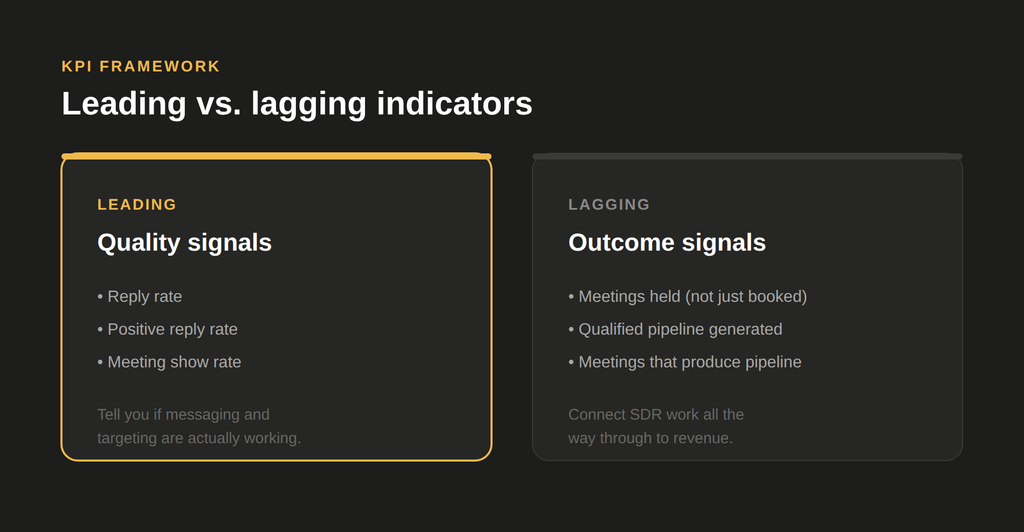
Track a small number of leading indicators tied to quality, not just volume. Reply rate, positive reply rate, and meeting show rate tell you whether the messaging and targeting are actually working, which raw send volume cannot. An SDR sending twice the emails of a teammate with half the reply rate is not necessarily doing better work, and a KPI dashboard built only around volume will reward the wrong behavior. For a fuller list of which numbers actually correlate with pipeline rather than just activity, it’s worth auditing your current dashboard against that framework directly.
Track meetings held and pipeline generated as the core lagging indicators, not just meetings booked. A meeting booked that no shows or turns out to be poorly qualified does not reflect real performance, even though it is the easiest number to report. Where possible, track the meeting all the way through to whether it produced qualified pipeline, since that is the number that actually connects SDR work to revenue.
Set targets based on funnel math specific to your team, not industry averages. If your team’s actual data shows it takes forty meetings to produce one closed deal at your current close rate and deal size, set SDR targets based on that math, not a generic benchmark pulled from an unrelated company’s blog post. This also means targets should get revisited as close rates and deal sizes shift, rather than staying fixed indefinitely.
Watch for metrics that quietly conflict with each other. A common failure mode is measuring both call volume and meeting quality without noticing that pushing one down often pushes the other up. If reps are hitting activity numbers by rushing through low quality outreach, the KPI system is rewarding the wrong thing even if every individual metric looks fine on its own.
Onboarding: The First 90 Days for a New SDR Hire
A new SDR’s ramp time has an outsized effect on both their performance and how long they stay on the team. A slow, unstructured ramp period is one of the most common, avoidable causes of early SDR turnover.
Weeks 1 to 2: product, market, and tooling, not quota. New hires need real time to understand what the company sells, who buys it, and why, along with hands on time in the CRM and sequencing tools before they are expected to produce results. Pushing a new SDR into live outreach in their first few days, before they understand the product or ICP, produces low quality messaging that damages both results and the rep’s early confidence.
Weeks 3 to 6: shadowing and supervised output, not solo production. Having new SDRs shadow calls, review top performers’ actual sent messages, and get their own early drafts reviewed before sending catches bad habits before they become ingrained. This is the same underlying logic behind having a review step before any AI generated outreach goes out, covered in quality assurance in AI powered outbound: a second set of eyes before something reaches a prospect catches problems a lot cheaper than fixing them after the fact.
Weeks 7 to 12: full production with close coaching, not just monitoring. By this point the SDR should be running full sequences independently, but with frequent enough 1:1 and call review time that issues get caught and corrected quickly rather than accumulating over months. Ramping down coaching intensity should be a deliberate decision based on demonstrated performance, not something that happens automatically once the formal onboarding period ends on the calendar.
Set an explicit ramp target and communicate it clearly. New SDRs should know from day one roughly when they are expected to be at full productivity, and what specific milestones they need to hit along the way. Ambiguity about what “ramped up” actually means creates unnecessary anxiety and makes it harder to identify a struggling hire early enough to help them.
Management Cadence That Actually Sustains Performance
Weekly 1:1s focused on pipeline and development, not status updates. A 1:1 that only reviews whether activity numbers were hit misses the opportunity to actually coach. Time spent reviewing specific messages, specific calls, and specific deals moves the needle more than a general check in on numbers.
Regular call and message review, not just end of quarter feedback. Waiting until a formal review cycle to give feedback on actual outreach quality means months pass with bad habits reinforced rather than corrected. A consistent, lightweight review rhythm, even fifteen minutes reviewing a handful of recent messages or calls, catches problems while they are still easy to fix.
A clear, visible path beyond the SDR role. SDR roles have meaningfully higher turnover when reps cannot see a defined path to an AE role or another next step. Publishing clear criteria for promotion, and revisiting them honestly with each rep, reduces the churn that comes from ambiguity about career progression.
The Underlying Point
Almost every common SDR performance problem traces back to a management decision rather than an individual rep’s skill: a mismatched structure, KPIs that reward the wrong behavior, an unstructured onboarding period, or a management cadence too thin to catch problems early. Fixing execution tactics matters, but it rarely fixes a team that has these structural issues underneath it. Get the structure, the metrics, and the ramp period right first, and the tactical coaching that follows actually has something solid to build on.
Building this well in-house is also how you build something an agency relationship can’t replicate: institutional knowledge that compounds as your SDRs grow with the product and the market, rather than knowledge that walks out the door when a contract ends.
If you’re still weighing whether to build this team at all, or want a sanity check on the structure you’ve already got, get in touch — it’s a conversation worth having either way.
Related: Quality Assurance in AI Powered Outbound, Should You Build an Outbound Team In-House or Work With an Agency?