
Outbound is hard enough when you’re selling something buyers already understand. But what happens when your product solves a problem the market doesn’t even know it has yet?
This is one of the most underestimated challenges in B2B sales. You’re not just competing with other vendors. You’re competing with the way things have always been done. And in some cases, your product doesn’t improve an existing workflow at all. It disrupts an entire business model built around a problem your product eliminates.
This article is for founders, sales leaders, and business development heads who are trying to build pipeline for a genuinely new-to-market product. If your challenge is more geographic than conceptual, our step-by-step playbook for entering a new market with cold outreach covers that scenario in more depth — here, we’re focused specifically on products the market doesn’t yet know it needs. You’ll learn how to frame your outreach, how to manage multiple buyer segments at once, and how to set realistic expectations for what early-stage pipeline actually looks like.
Why Selling a New Product Requires Educating Before Persuading
Most cold outreach advice assumes your prospect already understands the category you’re selling into. But when your product is truly new, that assumption breaks everything.
Think about the difference between selling a faster project management tool versus selling a platform that eliminates the need for a role that currently exists inside your prospect’s business. The first conversation starts with “here’s why we’re better.” The second conversation has to start with “here’s why this problem is costing you.”
When your product destroys an existing business model rather than improving a known workflow, the entire sales motion shifts. You’re not persuading someone to switch. You’re persuading them to see a problem they’ve normalized or built a business around. Getting this right is really a question of message-market fit — and as we lay out in our guide to finding message-market fit at scale, the gap between a 1% and a 15% reply rate almost always comes down to whether the message resonates with a problem the reader already recognizes.
This shows up clearly in industries built on information asymmetry. If your platform makes data transparent that was previously inaccessible or expensive to obtain, you’re not just selling software. You’re challenging the value of services, intermediaries, or entire advisory businesses that depend on that asymmetry existing.
In this context, cold outreach cannot open with features or pricing. It has to open with the cost of the status quo.
How to Frame Outbound for New Products: Lead With Inaction, Not Innovation
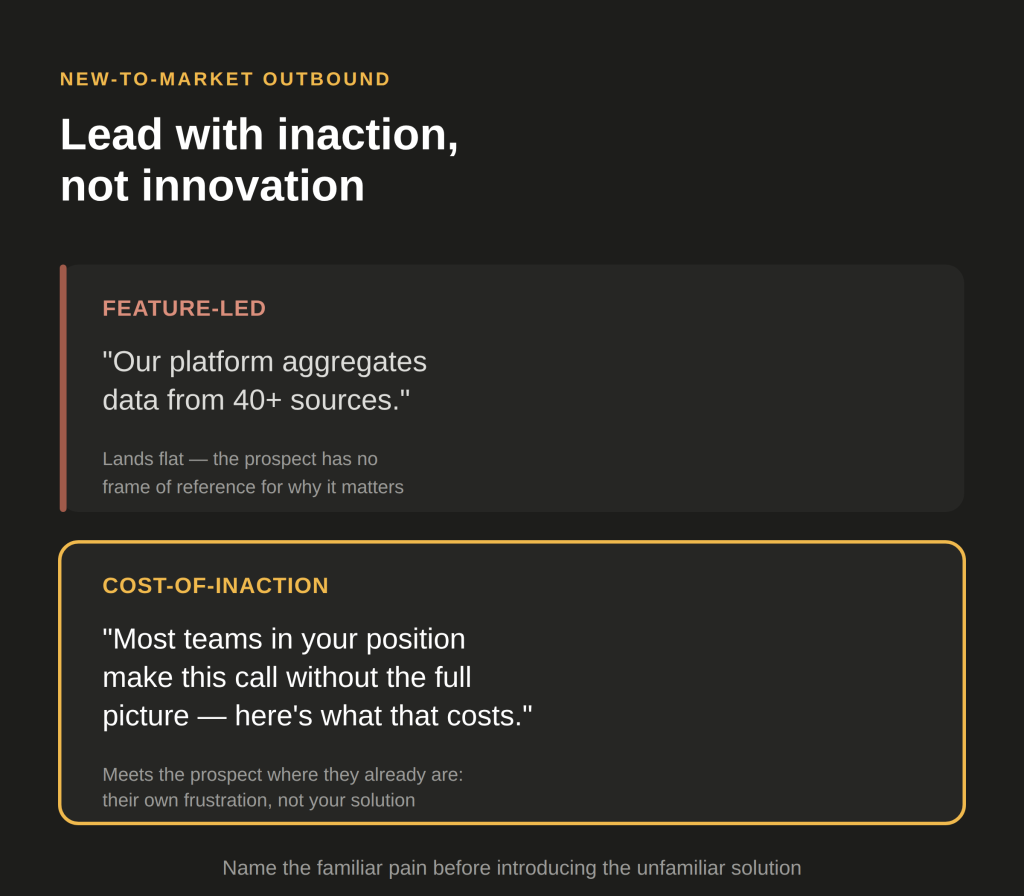
The biggest mistake teams make with new-to-market products is leading with what the product does. The prospect has no frame of reference. The message lands flat.
A more effective cold outreach strategy for new market entry is to frame every message around the cost of inaction. Not “here’s what our platform can do” but “here’s what continues to happen every month you don’t have visibility into this.”
This works because it meets the prospect where they are. They may not know your product exists, but they do know their own frustrations. Connect to those frustrations first.
A few practical ways to do this:
- Name the familiar pain before introducing the unfamiliar solution. If your product solves a data access problem, start by describing what decisions get made badly without that data.
- Use consequences, not capabilities. Instead of “our platform aggregates X data sources,” try “most teams in your position are making this decision without the full picture, and here’s what that typically costs.”
- Keep the ask small. You’re not asking for a buying decision in the first email. You’re asking for a conversation with someone who has a relevant problem. Frame the ask that way.
This approach does more than improve reply rates. It also filters for the right buyers. The prospects who respond to a problem-led message are the ones who recognize that problem in their own work. That’s your signal — and it lines up with the broader structural principles we cover in what actually makes a cold email get replies, where opening-line quality is consistently the biggest lever teams underuse.
Running Outbound Across Multiple Buyer Personas for One Platform
One of the more complex scenarios in B2B market education is when a single platform serves multiple fundamentally different buyer types. This isn’t just a messaging challenge. It’s a structural one.
The instinct is often to write one universal message that speaks to everyone. That message ends up speaking to no one.
Targeting multiple buyer types for one platform is entirely possible, but it requires separate messaging tracks for each persona from the very beginning. The same product, positioned differently based on who’s reading the email and what they care about. This is the same discipline behind persona-based segmentation in warm and cold outreach: different roles respond to different framings of the exact same offer.
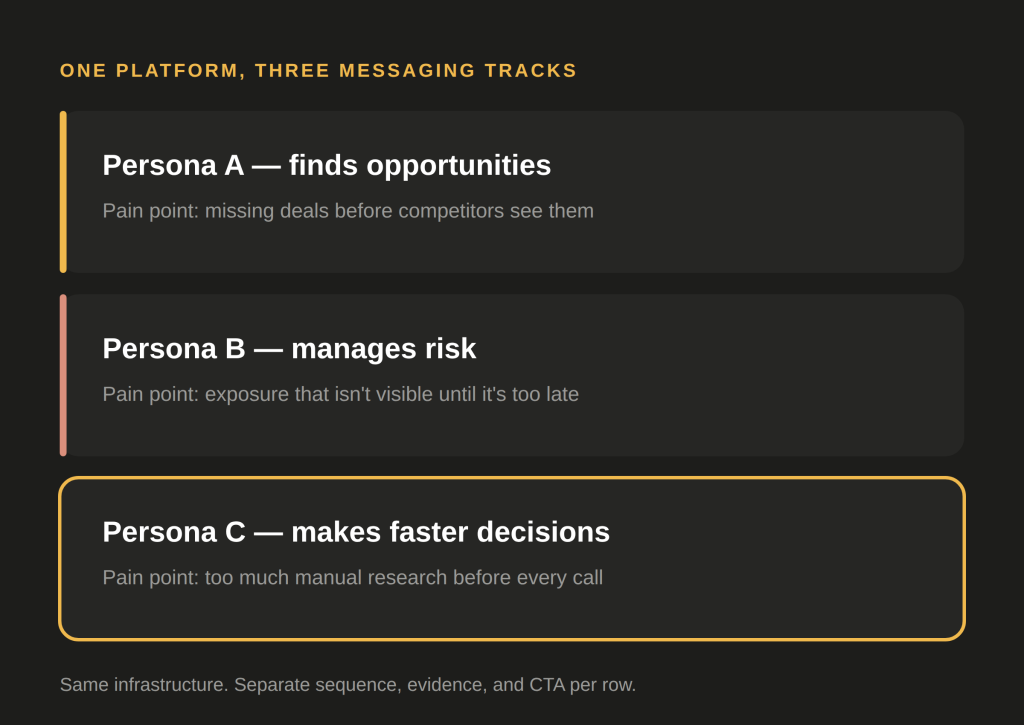
Consider a platform that serves three distinct buyer groups, each of whom approaches the product from a completely different angle. One group needs it to find opportunities. Another group needs it to manage risk. A third group needs it to make faster investment decisions. These are not the same conversation.
Here’s how to structure this practically:
- Map each persona to their specific pain point before writing a single line of copy. What problem does this person lose sleep over? What decision do they make repeatedly that your product makes easier or safer?
- Write a separate sequence for each persona. Subject lines, opening lines, calls to action, and even the evidence you use should differ by audience.
- Track performance by persona separately. If you pool all results together, you’ll never know which audience is responding and which isn’t. This matters especially in early-stage campaigns where you’re still learning.
The key insight is that you’re not running multiple campaigns. You’re running one outbound program with differentiated tracks. The infrastructure is shared. The messaging is not.
Setting Realistic Pipeline Expectations for New Market Entry
Here’s a conversation that comes up constantly with early-stage and category-defining products: the client wants to run a three-month campaign to see if outbound works.
Three months is a reasonable test for a product with established demand. It is too short to draw meaningful conclusions when you’re educating a market from scratch.
The reality of outbound for new products is that the first few weeks involve more signal-gathering than pipeline-building. You’re learning which personas respond. You’re learning which pain points resonate. You’re learning how prospects describe their own version of the problem you solve. That reframe — that early outbound is about learning, not booking meetings — is exactly what we walk through in setting realistic expectations for your first 90 days.
This is valuable, but it doesn’t fill a pipeline quickly. Here’s why a longer window matters:
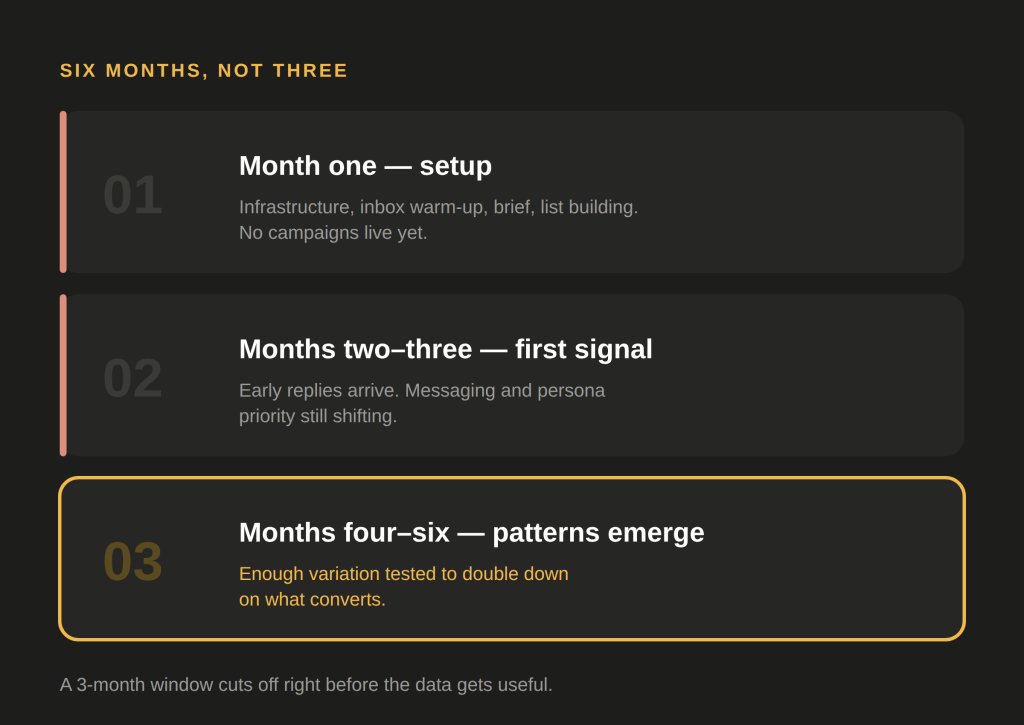
- Month one is typically setup: domain infrastructure, inbox warm-up, brief development, and initial list building. No campaigns are live yet.
- Months two and three are the first real tests. Early replies are arriving, but you’re still iterating on messaging. You may be pivoting which persona gets priority.
- Months four through six are where patterns emerge. You’ve now run enough variations to see what’s working. You can double down on what’s converting and cut what isn’t.
A three-month window cuts off right before the data gets useful.
Six months allows enough iterations to draw meaningful conclusions about a new market. That’s not a sales pitch for a longer contract. It’s a practical reality of how long B2B market education takes when you’re starting from zero awareness.
If budget is a genuine constraint, a pragmatic approach is to run two tracks in parallel: one for the new, unvalidated product and one for a more established offering. This keeps pipeline flowing while the new market education work runs its course. If you’d rather test the hypothesis in a structured, lower-volume way before committing to a full six-month program, our GTM market validation service is built for exactly that — small controlled experiments designed to produce signal, not just meetings.
FAQ
Standard cold outreach assumes the buyer understands the problem category and is potentially already looking for solutions. With a new-to-market product, buyers often don’t recognize the problem yet. Your outreach has to create that recognition before it can persuade. The messaging approach, the campaign timeline, and the metrics you track all need to adjust accordingly.
Yes, but each persona needs its own messaging track from the start. Trying to write one message that speaks to multiple buyer types usually results in a message that resonates with none of them. Separate sequences, separate subject lines, and separate calls to action are essential when personas have meaningfully different needs.
A minimum of six months is recommended when significant market education is required. The first month typically involves setup and warm-up. Real learning happens in months two and three. Months four through six are where you have enough data to optimize and start seeing consistent pipeline results. If you’re not yet sure the product-market hypothesis holds at all, it’s often worth validating it first — our guide to validating a new ICP in 30 days walks through a faster, smaller-scale way to get that first signal.
Lead with the cost of inaction rather than the features of your product. Describe the problem the prospect is already living with, name the consequences of not solving it, and position your product as the way out. This approach connects with buyers on terms they already understand before introducing something unfamiliar.
Yes. A combination of cold email and LinkedIn outreach works well because it creates multiple touchpoints that reinforce the same message. For products that require market education, repeated exposure across channels helps prospects move from unawareness to consideration more quickly than a single-channel approach.
Conclusion
Running outbound for a genuinely new product is one of the hardest sales challenges in B2B. The standard playbook doesn’t apply when your buyers don’t yet recognize the problem you solve.
The fundamentals that make it work are: framing every message around the cost of inaction, building separate messaging tracks for each buyer persona, and giving the campaign long enough to actually generate learning. Rushing a new market entry with a three-month test and generic messaging is almost guaranteed to produce inconclusive results.
If you’re trying to build pipeline for a category-defining product and you’re not sure where to start, get in touch and we’d be happy to talk through what a structured outbound approach — including a GTM validation phase — could look like for your specific situation.