

Clay looks deceptively simple in a ten minute demo. You watch someone build an enrichment waterfall, pull in intent signals, and generate personalized copy, and it feels like plug and play magic. Then your team buys it, and sixty days later, adoption has stalled, credits are gone, and nobody is quite sure who is supposed to be maintaining the tables.
This is not a tutorial on formulas or table setup. It is a breakdown of the operational and team level mistakes that quietly kill Clay adoption, based on what actually goes wrong once a sales team starts using it in practice.
Mistake 1: Treating Clay as a Tool Instead of a Workflow
Most teams buy Clay expecting it to behave like a standard enrichment tool: plug it in, get clean data out. In reality, Clay is closer to a workflow builder than a point solution. It needs to be designed, not just configured — in a Notion doc your ICP is a sentence, but in Clay your ICP has to become a formula.
The symptom is easy to spot. Credits get burned fast, tables multiply without a clear structure, and nobody can explain why a given column exists six weeks in. Clay implementation mistakes usually start here, at the assumption that the tool will do the thinking for you.
The fix is simple to state and harder to do: define the workflow logic before you open the interface. What data are you trying to produce, in what order, and why.
Mistake 2: No One Actually Owns It
Clay is often purchased by a founder or a RevOps lead, then handed off to “whoever is good with tools.” That person builds an impressive first version, gets pulled onto something else two weeks later, and the whole system quietly stops evolving.
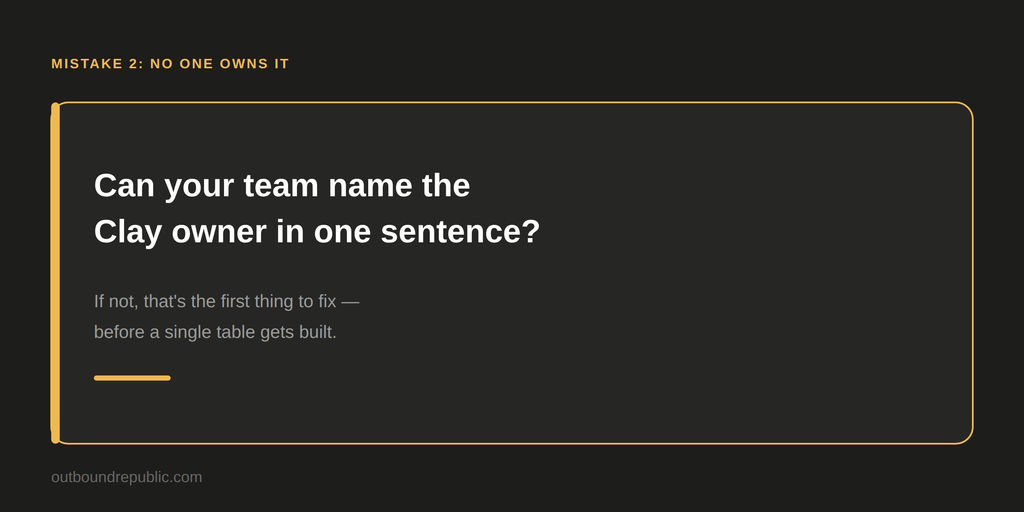
This is one of the most common Clay onboarding mistakes, and it is rarely about the tool itself. It is a staffing problem disguised as a tooling problem. Clay needs a named owner with dedicated time, not a side project squeezed between other responsibilities.
If your team cannot name the person responsible for Clay in one sentence, that is the first thing to fix, before any table gets built.
Mistake 3: Skipping the ICP and Data Model Before Building Tables
It is tempting to jump straight into enrichment waterfalls once the account is set up. The problem is that without a clear definition of what “qualified” and “relevant” actually mean for your team, you end up with data that is technically correct but practically useless.
We have written before about how to build an ICP when you have almost no customers yet, and the same principle applies here. Clay cannot fix a fuzzy ICP. It will just enrich the fuzziness faster and at scale.
Before building a single table, write down the specific signals that make a lead worth pursuing. That definition should drive the table structure, not the other way around.
Mistake 4: Underestimating Credit and Cost Management
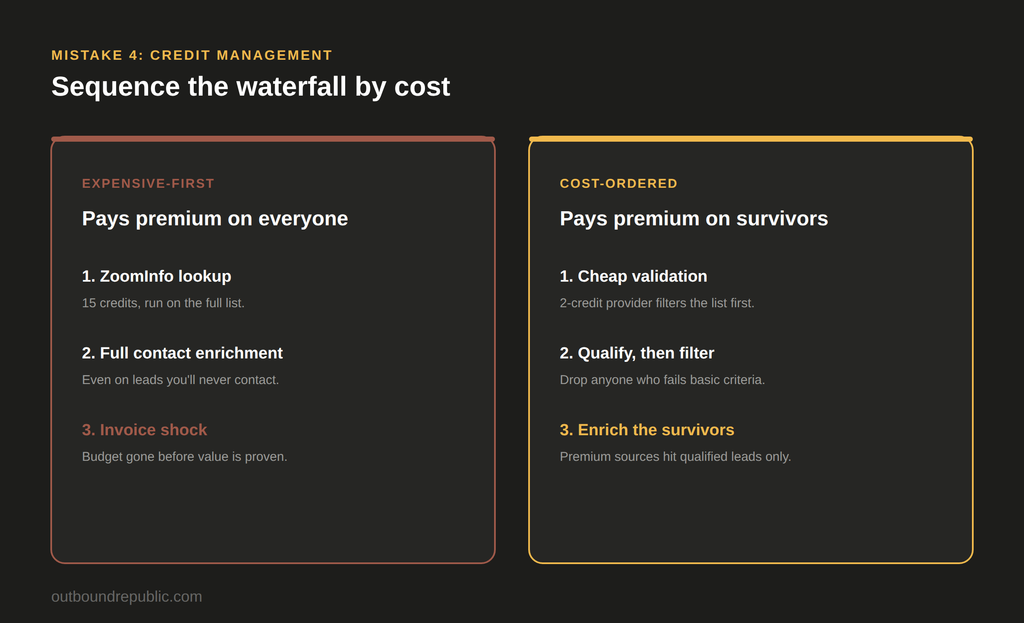
Enrichment waterfalls that call expensive data sources first are one of the fastest ways to burn through a Clay budget in the first month. Teams often discover this only after the invoice arrives, and it damages trust in the tool before it has had a chance to prove value.
The fix is sequencing. Run cheap validation steps first, filter out leads that do not meet basic criteria, and only send the remaining, qualified batch through the expensive enrichment sources. We go deeper on exactly how to restructure a waterfall by cost efficiency instead of provider reputation elsewhere, but the short version is: this single change often cuts cost per qualified lead dramatically, and it is one of the clearest, most fixable Clay implementation mistakes on this list.
Mistake 5: Copy Pasting a Template Without Adapting the Logic
Public Clay templates from YouTube and community channels are a genuinely good starting point. The mistake is using one as is, without adjusting it for your actual ICP, your data sources, or your messaging angle.
The result is outreach that is technically personalized, in the sense that fields are filled in correctly, but reads as generic to the prospect. This defeats the entire purpose of using Clay in the first place. We have covered why this matters on the deliverability and copy side in the hidden cost of bad prospect data, and the same logic applies to personalization quality, not just data accuracy.
Treat every template as a starting structure to rebuild around your own logic, not a finished product.
Mistake 6: No Feedback Loop Between the Data Layer and the Reps Sending
Clay output often gets treated as a one way pipe. Someone builds the tables, exports the leads, and the process ends there. Reps then notice bad enrichment or irrelevant personalization in the field, but there is no defined path for that feedback to reach whoever owns the Clay setup.
Without this loop, the same errors repeat indefinitely. A short, recurring review session between the Clay owner and the reps actually sending outreach fixes this. Treat the system as living and iterative, not a one time setup you configure and forget.
Mistake 7: No QA Step Before Messages Go Out
AI generated personalization fields are not correct one hundred percent of the time. Wrong company facts, broken merge fields, and awkward phrasing all make it into live campaigns when there is no review step before sending.
This is the same underlying lesson we covered in why you need a reviewer agent for quality assurance in AI powered outbound, just applied at the Clay layer instead of the campaign layer. Any AI assisted step in your pipeline needs a check before it reaches a prospect’s inbox, whether that check is human or automated.
What Good Clay Adoption Actually Looks Like
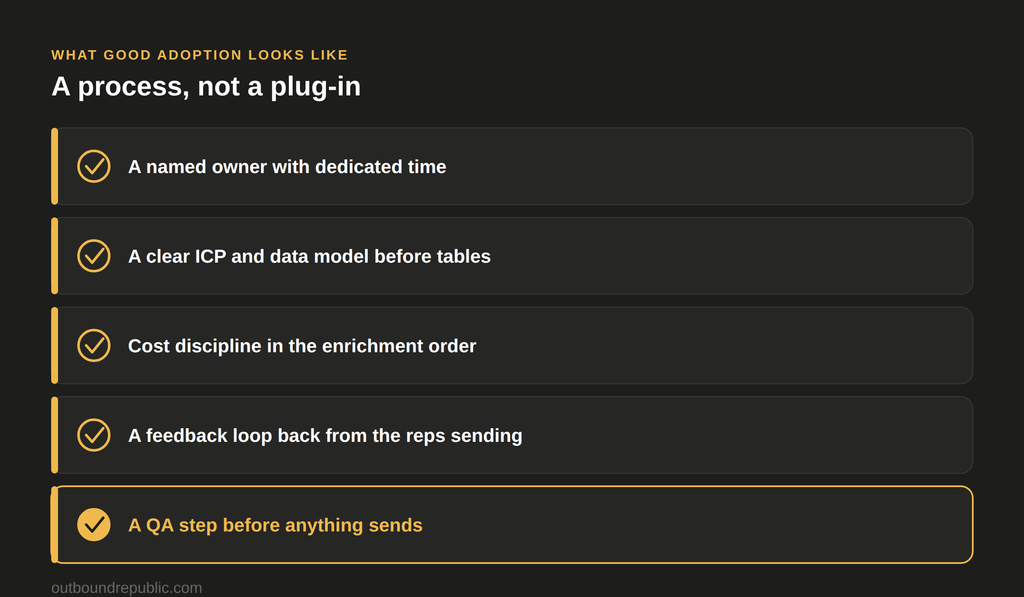
Every mistake above traces back to the same root cause: treating Clay as a plug in instead of a process. A process needs an owner, a clear data model, cost discipline, a feedback loop, and a QA step. Tools do not need any of that. Workflows do.
Teams that get real value from Clay within the first quarter are rarely the ones with the most advanced formulas. They are the ones who set up ownership and review cycles before they scaled the build. That is also the gap we most often step in to close for clients — if you are staring down a stalled rollout, get in touch and we will help you find where it broke.