

In most B2B sales, finding the decision maker is a matter of looking at the org chart. In public sector and education, that approach fails more often than it works.
The person with the budget rarely understands the product. The person who understands it rarely holds the budget. A third person, whom you may never meet, can end the deal with one sentence about compliance. And the formal process, which may involve committees, quotes or a tender, can matter more than the conversations you have.
This post maps the roles that typically sit around a public sector or education purchase, what each of them cares about, and how to run outbound across all of them without sending the same message to everyone.
One caveat first. Public bodies differ widely by country, region and institution type, and procurement rules change with the size of the purchase. Treat this as a framework to adapt, not a description of every organization.
Why “who makes the decision” is the wrong question
In public sector and education, decisions are usually shared, staged and constrained by rules.
- Shared: several people have to agree, and each can say no
- Staged: different people matter at different points (discovery, evaluation, approval, contracting)
- Constrained: budgets, procurement rules and compliance requirements limit what anyone can choose, whatever their title
A better question is: who influences, who approves, who can block, and who runs the process?
The map
These are the roles you will most often meet. Titles vary, and one person may hold several roles, particularly in smaller institutions.
| Role | Typical examples | What they care about | Their power |
|---|---|---|---|
| End user | Teachers, lecturers, caseworkers, clinicians, front-line staff | Does it make my work easier? Will I need to retrain? | Influence, and adoption after purchase |
| Champion | A department head, a program lead, an innovation officer | Solving a problem they own, being seen to improve things | Influence, and often the person who starts the purchase |
| Technical and IT | IT manager, systems administrator, security officer | Integration, security, hosting, maintenance burden | Can block |
| Academic or program leadership | Head of department, curriculum lead, program director | Fit with goals, outcomes, evidence it works | Influence, sometimes approval |
| Data protection and legal | Data protection officer, legal counsel | Personal data, privacy rules, contract terms, liability | Can block |
| Finance and procurement | Budget holder, procurement officer, purchasing team | Budget availability, value, process compliance, comparing offers | Approval, runs the process, can block on process |
| Executive or governing body | Head teacher, principal, director, board, trustees, council | Strategy, risk, reputation, cost | Final approval on larger purchases |
| External parties | Funding bodies, consortia, regional authorities, approved supplier lists | Whether it fits funding conditions and approved routes | Can enable or block the whole purchase |
The three groups that matter most
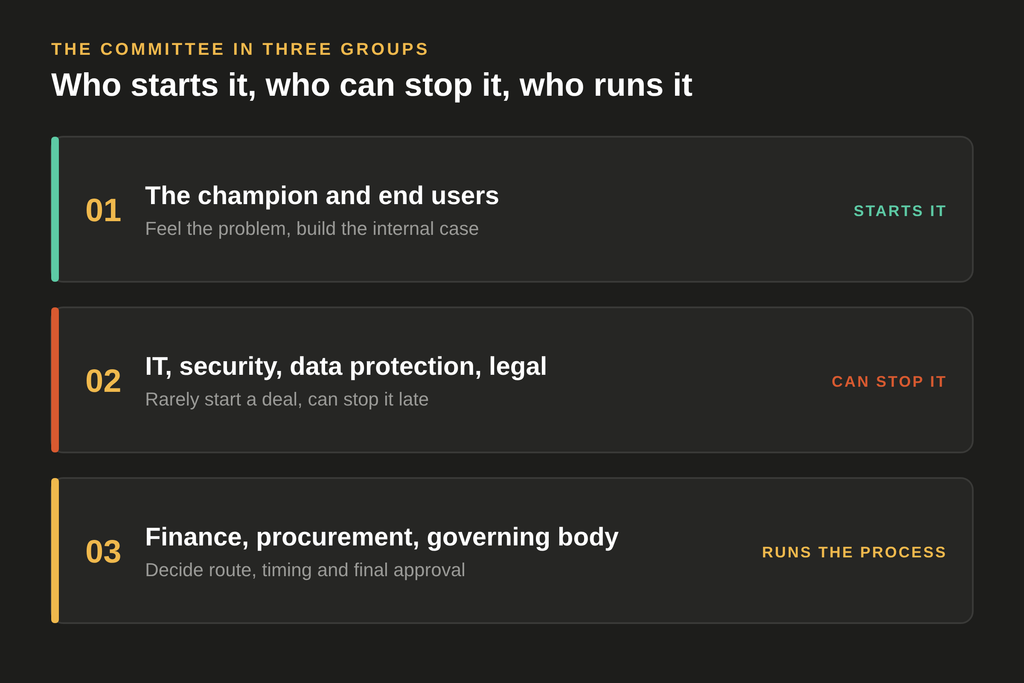
Not every role carries equal weight at every stage. In practice, three groups shape most outcomes.
1. The champion and the end users
- They feel the problem and want it solved
- They give you the story and the internal case
- Without them, nothing starts
- By themselves, they usually cannot sign anything
2. The gatekeepers who can say no
- IT and security, and data protection and legal (see selling to IT and DevOps teams for the technical side, and GDPR and cold email for the data protection side)
- They rarely start a purchase, but they can stop one late and without much warning
- Their concerns are practical: where is the data stored, who can access it, what happens when the contract ends
- Meeting them early costs you a conversation, while meeting them late can cost you the deal
3. The people who control the process
- Finance, procurement and the final approvers
- They decide whether the purchase can happen at all, through which route, and by when
- Small purchases may be a quick approval, while larger ones may require formal quotes or a tender
- Your champion often does not know the details, so you need to find out
- We look at the procurement side in outbound to manufacturing companies, where many of the same dynamics apply
Who actually decides?
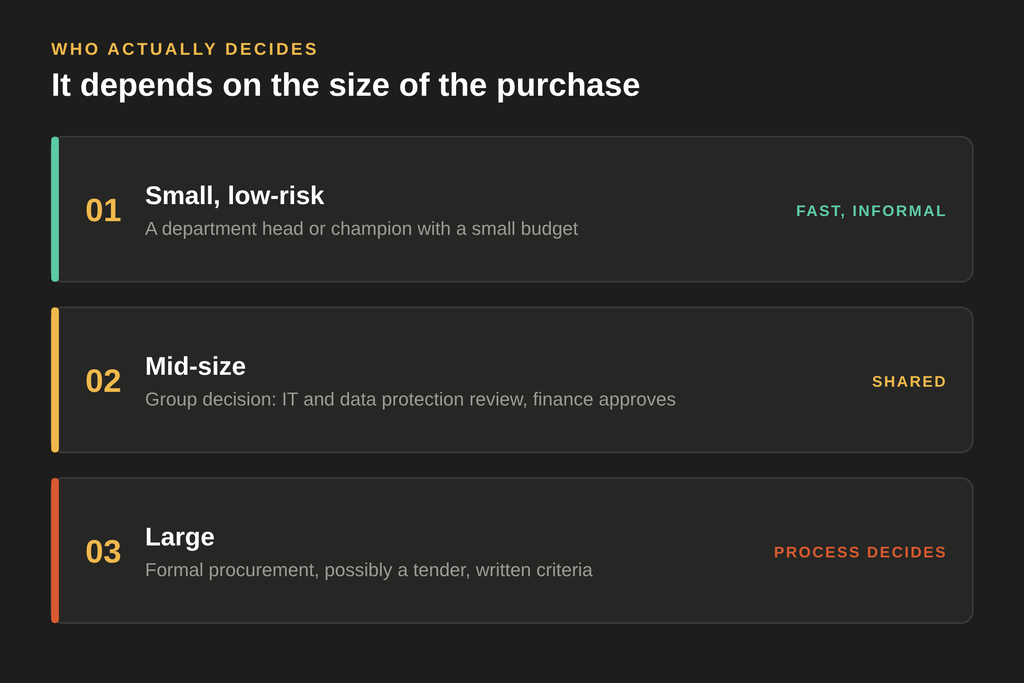
It depends on the size and type of the purchase.
- Small, low-risk purchases: often a department head or champion with a small budget. The decision can be fast and informal.
- Mid-size purchases: a group decision, with IT and data protection reviewing, and finance approving
- Large purchases: formal procurement, possibly a tender, with documented criteria and several evaluators. Here, how well you meet the written criteria can matter more than any relationship.
So the real answer is usually: the champion starts it, the gatekeepers can stop it, and the process decides when and how it ends.
What this means for outbound
Generic outbound fails here because it assumes one buyer. Here is what works better.
1. Start with the person who owns the problem
- Target the likely champion, such as a program lead, department head or innovation role, with a message about the problem, not the product. Starting with the person rather than the company is a trade-off we weigh in people-first vs company-first prospecting
- Keep the first message short and specific to their work
2. Write a separate message for each role
- Champion: the problem and the outcome
- IT and security: integration, hosting, security practices
- Data protection and legal: data handling and compliance
- Finance and procurement: cost, contract, how you fit their process
- Do not send the same email to everyone with a different name in it. We covered the same mistake in outbound in niche B2B markets.
3. Prepare the documents before they are requested
- Security and data protection information
- A clear explanation of how personal data is handled
- Pricing and contract basics
- References from similar institutions
- Having these ready shortens a slow process, and shows you understand how these buyers work
4. Learn the purchasing route early
- Ask your champion: who else needs to approve this? What is the budget source? Is there a formal process above a certain value? When is the budget decided?
- If a tender or approved supplier list is involved, find that out before investing months of effort
5. Time your outreach to budget and planning cycles
- Many public bodies and schools work to annual or term-based cycles
- Reaching out when budgets are being planned usually works better than reaching out after they are fixed
- Ask when decisions for the next year are made, instead of guessing
6. Plan for a long cycle
- Public sector and education sales often take longer than commercial sales, and stall when people are away or processes are waiting on others
- Build follow-up into a longer sequence, spread across channels (see why email and LinkedIn combinations outperform single-channel campaigns), so the campaign does not look abandoned when the buyer is simply working through approvals. We discuss this pattern in why cold outbound struggles in long sales cycle industries.
7. Use pilots and small starts carefully
- A small pilot can fit within a department’s budget and avoid a formal process
- It also lets end users build the internal case
- Check the rules first: some bodies limit how pilots can lead into larger purchases
How to map your own committee
For each account you pursue, a simple exercise helps. Fill in one row per person:
| Name and role | Influence (high / medium / low) | Stance (supportive / neutral / skeptical / unknown) | What they care about | What I need from them | Contact so far |
|---|
Then check:
- Do I know who the champion is?
- Have I reached IT and data protection, or only the champion?
- Do I know who approves the purchase, and by which route?
- Which concern could block this deal, and have I addressed it?
- Who is a skeptic, and what would change their mind?
If many cells say “unknown,” that is your next set of questions, not a reason to wait.
Common mistakes
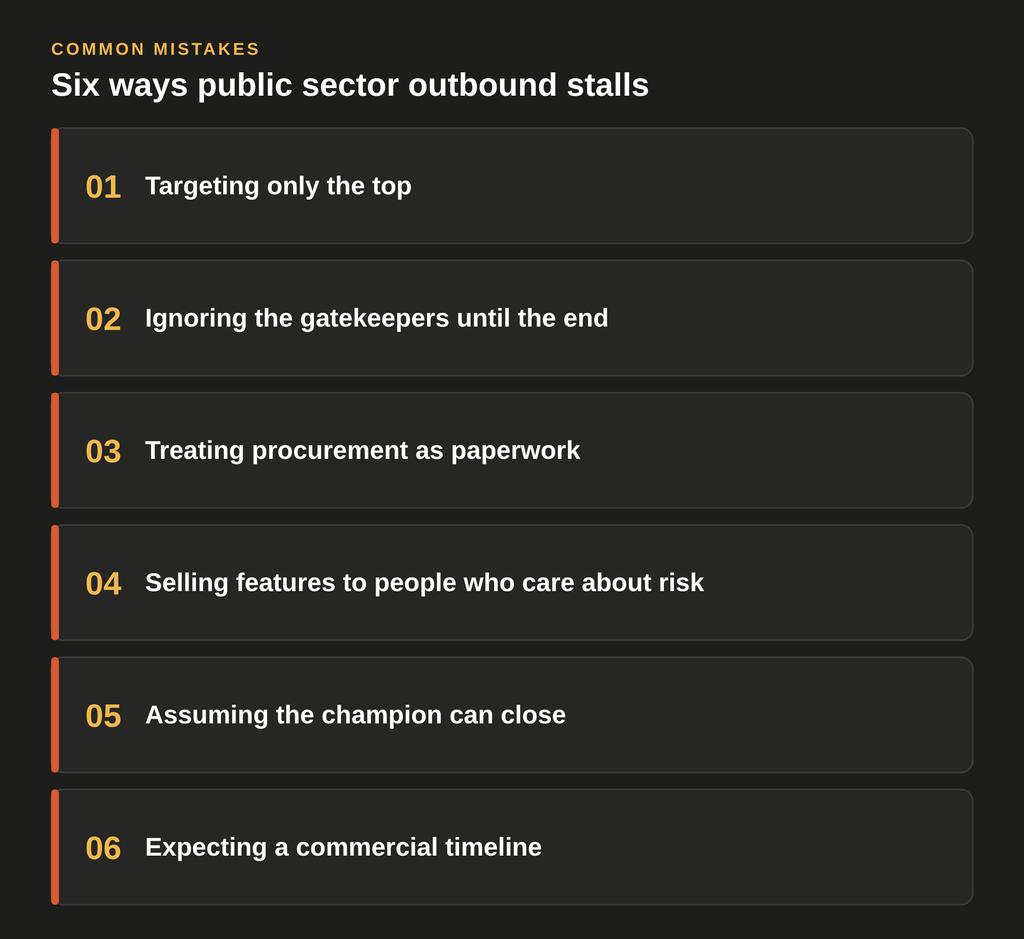
- Targeting only the top. A head of institution rarely has the time or detail, and will often pass your email down, or ignore it.
- Ignoring the gatekeepers until the end. IT and data protection objections that come late can undo months of work.
- Treating procurement as paperwork. The process is the deal in many public purchases.
- Selling features to people who care about risk. Public buyers are often rewarded for avoiding mistakes, not for taking a chance on something new.
- Assuming the champion can close. They can open the door and build the case, but often cannot approve the purchase.
- Expecting a commercial timeline. Cycles are longer, and pushing harder often backfires.
Summary
In public sector and education, the question is not “who is the decision maker?” It is who starts it, who can stop it, and who runs the process. The champion starts it, IT and data protection can stop it, and procurement and the governing body run the process and approve it.
Teams that map all of these roles early, write for each of them, and prepare the documents each will ask for, tend to run shorter and less surprising cycles than teams that find them out one by one.
If you want outbound built around the whole committee rather than a single contact, see our cold email outreach service or get in touch.