
Pay-per-lead feels like the lower-risk choice on paper. You only pay for what gets delivered, the cost per unit is fixed and predictable, and it feels less like a commitment than a monthly retainer. That instinct makes sense for some businesses. It is also, for a large portion of B2B companies, backwards once you factor in two variables that get skipped in most pricing comparisons: average contract value and sales cycle length.
This is not an argument that one model is universally better. It is an argument that the right model depends heavily on the shape of your deal, and that the shape of your deal changes the actual incentives each pricing structure creates, not just the invoice you receive. If you are still deciding whether to bring this in-house or work with an agency at all, that is a separate, earlier question worth settling first — we covered it in should you build an outbound team in-house or work with an agency.
How Each Model Actually Works
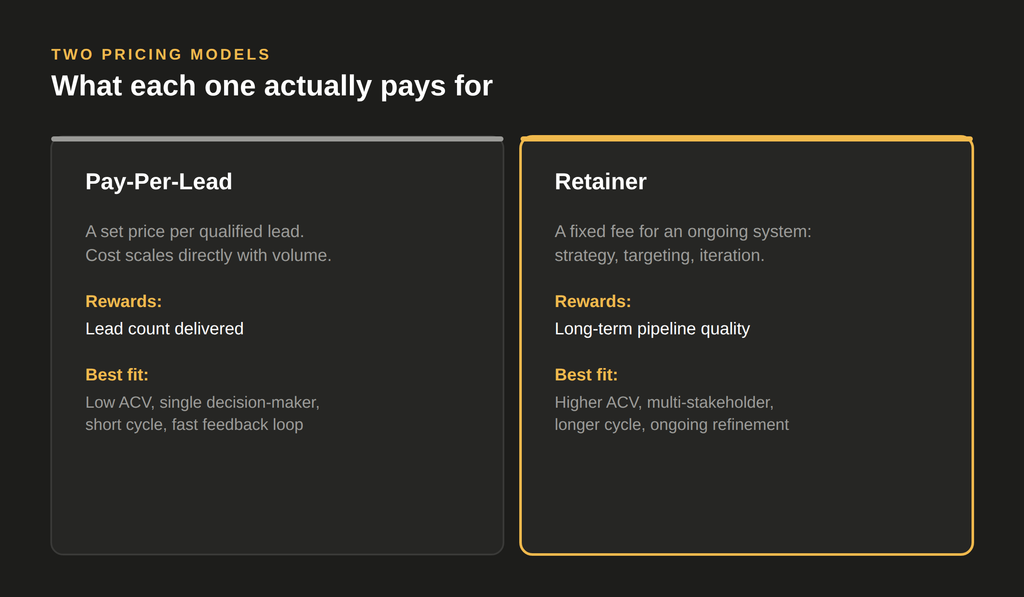
Pay-per-lead means you pay a set price for each qualified lead an agency delivers. The agency absorbs more of the risk on list building and targeting, and your cost scales directly with volume. The genuine appeal here is real: cost predictability per unit, and a lower perceived commitment if things do not work out.
Retainer means a fixed recurring fee for an ongoing program that covers strategy, targeting, testing, messaging iteration, and delivery over time, not a per-unit charge for leads handed over. You are paying for a system and its improvement over the length of the engagement, not for a countable unit of output.
Both are legitimate structures. The question is which one’s incentives actually match how your specific deal closes.
Why Pay-Per-Lead Breaks Down as ACV and Cycle Length Increase
The definition of “qualified” gets harder to pin down as complexity rises
In a short-cycle, lower-ACV sale with one decision maker, “qualified lead” is a fairly stable, checkable definition: right title, right company size, right stated interest. In a longer-cycle, multi-stakeholder, higher-ACV sale, what counts as genuinely qualified shifts depending on deal stage, which stakeholder you are talking to, and timing — the same ambiguity we get into in what is a lead, and why sales teams define it differently. A pricing structure paid strictly per lead creates pressure toward volume and technically-qualifying leads, not necessarily leads likely to actually close, because the payment event happens at delivery, not at outcome.
The model assumes a fast, visible feedback loop
Pay-per-lead works best when you find out relatively quickly whether a lead converts, so the agency can adjust targeting and messaging based on real signal. A six to twelve month enterprise cycle means the agency is optimizing against an outcome it will not see confirmed for months. In that gap, the only metric it can actually control and get paid on is lead count, which is exactly the metric that matters least once cycle length stretches out — one of several reasons lead count alone is a weak signal, covered in more depth in 7 outbound metrics that actually matter.
Complex, high-ACV deals need account-level judgment, which a per-lead structure discourages
The work that actually moves a complex deal forward, account-based personalization, multi-threading across a buying committee, adjusting messaging based on what a specific account’s stakeholders actually care about, takes more time and effort per lead, not less. A pricing model that pays a flat rate per lead delivered has no built-in incentive to invest that extra effort, since the payout is identical whether the lead came from five minutes of list-building or five hours of account research.
Retainer aligns the incentive with what actually matters at higher ACV
This is not paying for effort instead of results. It is paying for a structure where the agency’s incentive is long-term pipeline quality and continuous program improvement, rather than maximizing lead count within a fixed unit cost. When the value of a single closed deal is large enough to justify real strategic work, a model built around ongoing iteration tends to produce that work. A model built around per-unit delivery tends not to. The same discipline shows up on the buyer’s side too — qualifying outbound leads properly from meeting to revenue only works if the upstream incentive was never just to maximize the number of meetings booked.
Where Pay-Per-Lead Genuinely Still Makes Sense
To be fair to the model: it holds up well in specific situations, and it is worth naming them clearly rather than dismissing the option outright.
Lower ACV, transactional, single-decision-maker sales, where “qualified” is simple and stable to define, and where the sales process does not benefit much from deep account-level customization.
Very short sales cycles, where feedback on lead quality comes back fast enough that the incentive structure can actually self-correct in near real time, closer to how the model is designed to work.
Early market or ICP testing, where the flexibility to pause or scale volume quickly matters more than deep, ongoing account work, since the goal at that stage is learning fast, not optimizing a mature process.
If your business fits clearly into one of these situations, pay-per-lead is a reasonable, defensible choice, not a mistake.
A Simple Way to Place Yourself
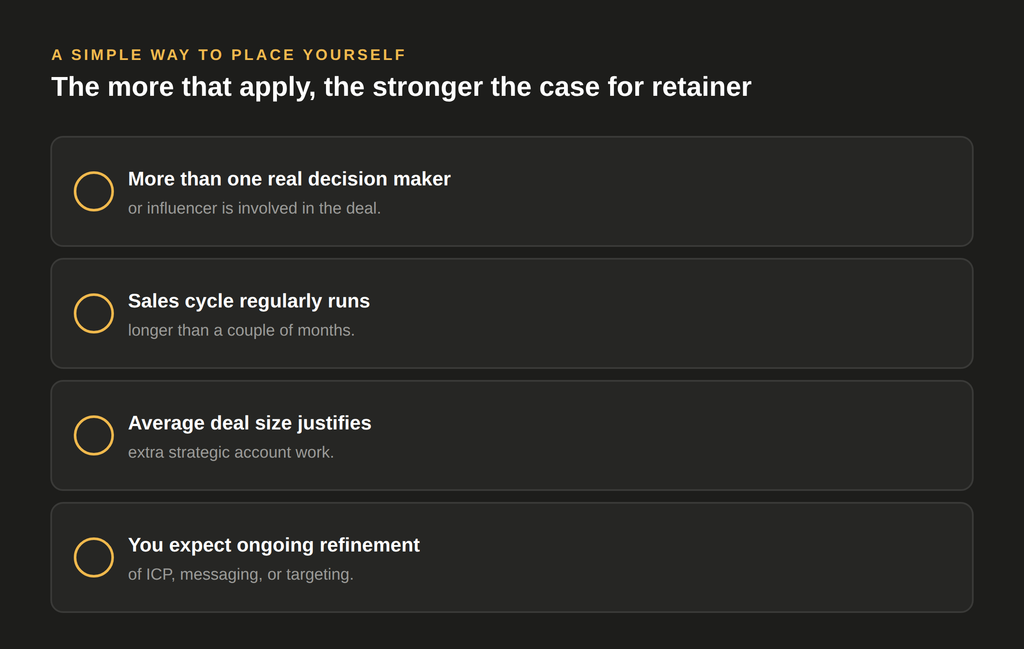
Rather than a hard rule, use this as a quick self-check. The more of these that apply, the stronger the case for retainer over pay-per-lead:
- Your sale involves more than one real decision maker or influencer
- Your sales cycle regularly runs longer than a couple of months
- Your average deal size is large enough that a handful of extra closed deals per year clearly justifies more strategic account work
- You expect to be refining ICP, messaging, or targeting on an ongoing basis, not running a single fixed campaign
If most of these describe your business, a per-lead structure is working against the kind of program that actually produces results for you, regardless of how predictable the invoice looks. Getting this right starts before the pricing conversation even happens — it is part of what should go into how you brief a lead gen agency in the first place.
Retainer Does Not Mean Paying Without Accountability
The instinct toward pay-per-lead often comes from a fair concern: retainer can feel like paying regardless of outcome. A well-run retainer should not work that way. It should include a regular reporting and pipeline review cadence, ongoing testing and iteration built into the engagement rather than billed separately as extras, and clear visibility into what changed and why between review periods. We covered what good onboarding and accountability inside an agency relationship should actually look like in your first 90 days with an outbound agency, and the same expectations apply well past the first quarter, not just at the start.
FAQ
Neither is inherently cheaper — the right comparison is not cost per lead but cost per closed deal against the actual sales cycle. Pay-per-lead can look cheaper per unit while producing leads that are harder to close, especially once average contract value and cycle length increase.
When the sale is lower ACV and transactional with a single decision maker, when the sales cycle is short enough that lead quality feedback comes back quickly, or when the priority is fast, flexible testing of a new market or ICP rather than deep account work.
Because the incentive structure only rewards lead count at the point of delivery, not outcome. In a long cycle, the agency will not see whether a lead actually closes for months, so lead count becomes the only metric it can control and get paid on — which is the metric that matters least once a deal involves multiple stakeholders and a longer evaluation process.
The Real Question to Ask
The question worth asking is not which model is cheaper per lead delivered. It is which model’s incentives actually match how your deal closes. For a transactional, low-ACV, short-cycle sale, pay-per-lead’s simplicity is a genuine fit. For most B2B companies with meaningful deal size and any real sales cycle, a retainer built around ongoing strategy and iteration is not the safer-sounding option, it is the structure actually built for the work that kind of deal requires. The businesses that get the best long-term results are rarely the ones optimizing for the lowest cost per lead. They are the ones whose pricing model rewards the agency for getting the right deals closed, not just the leads counted.
If you are not sure which shape your own deal is, or want a second opinion on whether your current pricing model is actually working against you, get in touch — it is a quick conversation, and it is exactly the kind of structural question we help teams work through before we ever talk about our outreach services.