

You’ve built a solid prospect list. Your copy is sharp. Your sequences are ready to go. Then you hit send from a brand new domain and watch your campaign disappear into spam folders across the board.
This is one of the most common and most avoidable mistakes in outbound email. Email warm-up isn’t optional. It’s the foundation that determines whether your messages ever get seen at all.
This article breaks down exactly what email warm-up is, why spam filters flag new domains, and how a properly structured sending infrastructure protects your deliverability and your main domain reputation at the same time. If you want the fuller technical playbook after this, our free deliverability ebook goes deeper on domain setup, authentication, and AI-powered personalization.
What Is Email Warm-Up and Why Does It Matter?
Email warm-up is the process of gradually building a sending reputation for a new domain or mailbox before you use it for live campaigns.
When a domain is brand new, it has no history. Email providers like Google and Microsoft have no data on whether it belongs to a legitimate sender or a spammer. Because spammers frequently create fresh domains in bulk and blast thousands of emails immediately, spam filters treat new domains with heavy suspicion by default. This got noticeably stricter with Google’s 2025 spam filter changes, which pushed the tolerated spam-complaint threshold down and made authentication and engagement quality matter more than ever.
Sending cold emails at volume from a fresh domain without warm-up almost guarantees spam folder placement. In some cases, it can permanently damage the domain’s sending reputation before a single real conversation takes place.
The warm-up process solves this by teaching inbox algorithms that your domain behaves like a legitimate sender. It does this through a gradual ramp of sending activity that mimics real human email behavior over time.
How Warm-Up Tools Actually Work
Modern warm-up tools work by connecting your new mailboxes to a large network of other mailboxes. These mailboxes automatically send emails to each other, open them, reply to them, and move them out of spam when they land there.
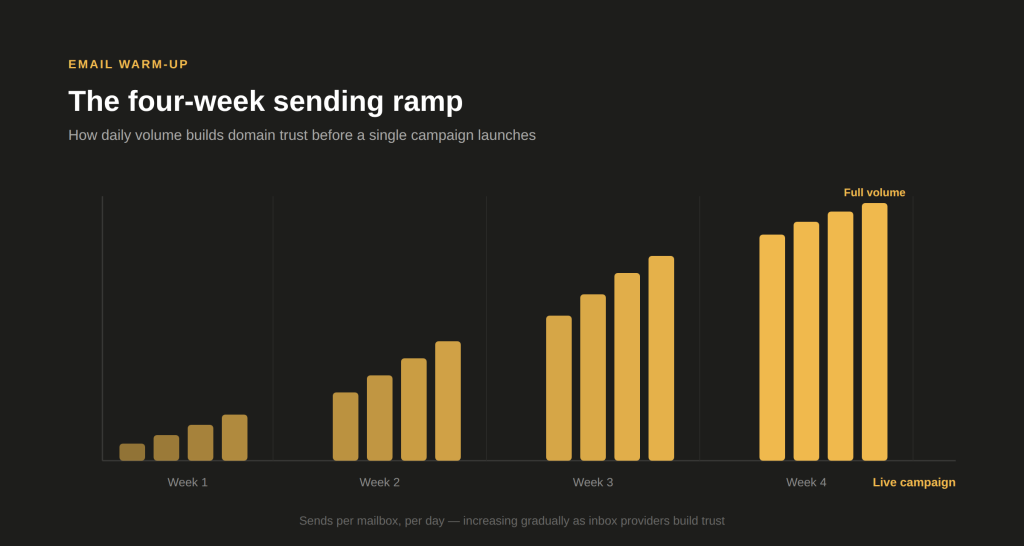
Here is what that process looks like in practice:
- Your new mailbox starts by sending a small number of emails per day (typically 2 to 5)
- The warm-up network receives those emails and interacts with them positively
- If an email lands in spam, the tool automatically marks it as “not spam”
- Sending volume increases gradually over the warm-up period
- Inbox algorithms observe this behavior and begin treating the domain as reputable
This simulated activity conditions the spam filter to associate your domain with normal, wanted email behavior. There is no shortcut that replaces this. Attempting to skip it and launch cold email campaigns from day one is a fast path to blacklisting.
A typical warm-up period runs four weeks. It is not a rigid science, but the consensus across deliverability professionals is that four weeks of consistent warm-up activity gives a new domain a solid foundation before live outreach begins. In our Evoltec case study, this is exactly the step that got every sending account to a 99–100% health score before a single campaign email went out.
Sending Domain Setup: Protecting Your Main Brand
One of the most important decisions in outbound infrastructure is where you actually send from. Sending cold email directly from your primary business domain is a serious risk. This is the single rule we come back to most often in how to protect your main domain from deliverability damage: never send cold outreach from the domain your whole business depends on.
Cold outreach, by nature, goes to people who did not ask to hear from you. A percentage of recipients will mark emails as spam, regardless of how relevant or well-written they are. If that happens at scale from your main domain, you risk damaging the email reputation that your entire company relies on for internal communication, client relationships, and every other business email you send.
The correct approach is to create separate sending domains that mirror your main brand.
For example, if your main domain is yourbusiness.com, you might create variations like:
- yourbusinesshq.com
- teamyourbusiness.com
- yourbusiness-outreach.com
These domains are set up with proper technical authentication including SPF, DKIM, and DMARC records. They also typically redirect to your main website so that anyone who looks them up lands somewhere credible rather than a blank page.
This matters more than most people realize. Even the naming convention of a domain and whether a landing page exists can influence spam filter decisions. A domain with no website, no history, and no authentication signals is far more likely to be flagged than one that looks like it belongs to a real organization.
Each sending domain can host multiple mailboxes, and each mailbox sends at a low individual volume. This approach lets you reach significant scale in aggregate while keeping any single domain well within safe sending limits. It’s the same infrastructure layer we build as standard in our cold email outreach service — domain health engineered in before a single message goes out.
The Real Cost of Skipping Warm-Up
Skipping email warm-up does not just hurt one campaign. The consequences compound.
Immediate consequences include:
- Emails land in spam instead of the inbox
- Open rates are near zero because nobody sees the messages
- Recipients who do find the emails in spam may mark them, compounding the reputation damage
Longer-term consequences include:
- Domain reputation damage that is difficult or impossible to repair
- Risk of landing on email blacklists used across multiple providers
- Contamination of your main domain reputation if you sent from there
There is also a less obvious cost: data quality. When your emails go to spam, you have no way to know if your campaign itself is working. You cannot improve copy, timing, or targeting when your core infrastructure is failing silently. You end up making decisions based on misleading data.
Building the infrastructure correctly from the start means that when you analyze campaign results, you are looking at real signal rather than noise created by deliverability failure. Skipping warm-up is also how teams fall into what we call the domain burnout cycle — buying a new domain every time deliverability collapses instead of fixing the sending behavior that caused it.
FAQ
A standard warm-up period runs four weeks for a new domain. Some practitioners extend this to six weeks for extra caution. The goal is to build consistent sending history before any live campaign goes out. Rushing this process defeats the purpose.
It is generally not recommended. The warm-up period is specifically designed to establish reputation without the risk of real-world spam complaints. Mixing live cold outreach into the warm-up window introduces variables that can stall or reverse the reputation-building process.
Your main domain carries the reputation of your entire business. Cold email campaigns generate some spam complaints by default, even with excellent targeting. Sending from separate domains protects your primary brand from deliverability damage while still allowing outreach at scale.
No warm-up tool guarantees inbox placement. What they do is significantly improve your starting position by establishing a sending history before live campaigns begin. Deliverability also depends on email content, authentication setup, list quality, and sending behavior over time.
Domain blacklisting is difficult to reverse and sometimes impractical to recover from. In most cases, a blacklisted domain needs to be retired and replaced entirely. This means rebuilding infrastructure, repeating the warm-up process, and losing whatever sending history the domain had accumulated.
Conclusion
Email warm-up is not a technical formality. It is the process that determines whether your cold email campaigns have any chance of working at all. Skipping it risks permanent damage to your sending infrastructure and delivers zero return on all the work that goes into building lists, writing copy, and planning sequences.
A properly structured approach means creating dedicated sending domains, warming them up over four weeks before any live outreach, and protecting your main domain from the risks that come with cold email at scale. Get the infrastructure right first and every other part of your outbound system works the way it is supposed to.
If you want outbound done correctly from the ground up, without managing the technical complexity yourself, that is exactly what our fully managed cold email service is built to deliver. Get in touch if you’d like it handled for you.