
If you’ve been running B2B outbound for any length of time, you’ve probably asked this question: should we focus on cold email or LinkedIn? Both channels can generate pipeline. Both have their champions. And both will underperform if you use them the wrong way.
The honest answer isn’t a simple winner. It depends on your ICP, your market, and how you’re sequencing outreach. But there is real data to work from — and the patterns are clear enough to make smarter decisions.
The Real Numbers: How Each Channel Performs
Let’s start with what the data actually shows — not theoretical benchmarks, but patterns from real outbound campaigns.
Cold Email: High Volume, Lower Response Rates
Cold email is the default channel for most B2B outbound teams. It scales easily, costs relatively little per contact, and can be highly automated. But the response rates tell a sobering story.
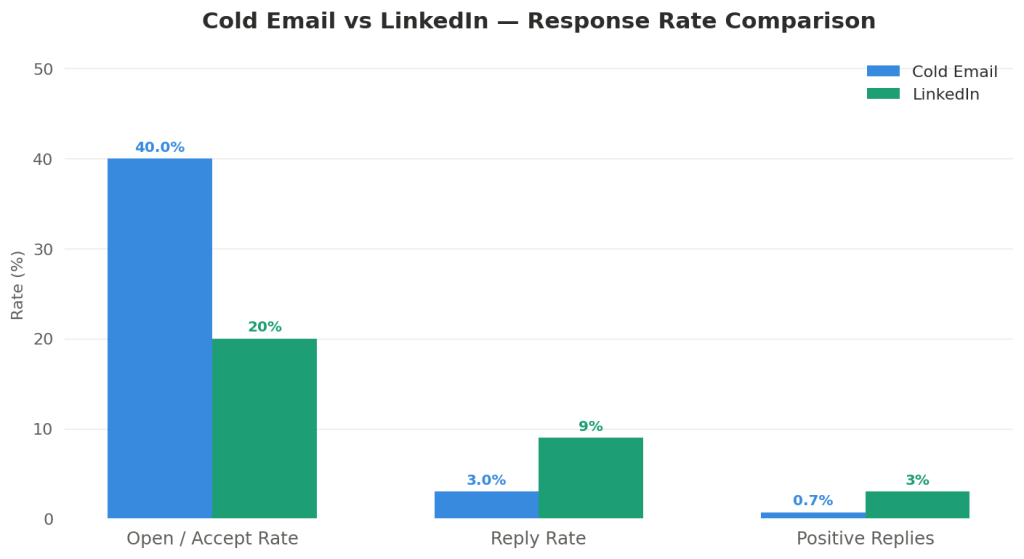
In a typical B2B cold email campaign targeting mid-to-senior decision-makers, you can expect:
- Open rates of 30–50% (with good deliverability setup)
- Reply rates of 1–5% for well-written, targeted sequences
- A significant portion of those replies being polite rejections
In one representative campaign targeting over 560 contacts, only 8 replies came back — and just 4 were genuinely positive. That’s a positive response rate under 1%. Even accounting for pipeline value, those numbers require serious volume to generate consistent meetings.
LinkedIn: Fewer Touches, Higher Engagement
LinkedIn consistently shows stronger engagement rates in B2B contexts, particularly for complex, relationship-driven sales. When targeting the same seniority of decision-maker, LinkedIn outreach regularly generates response rates 3–5x higher than cold email.
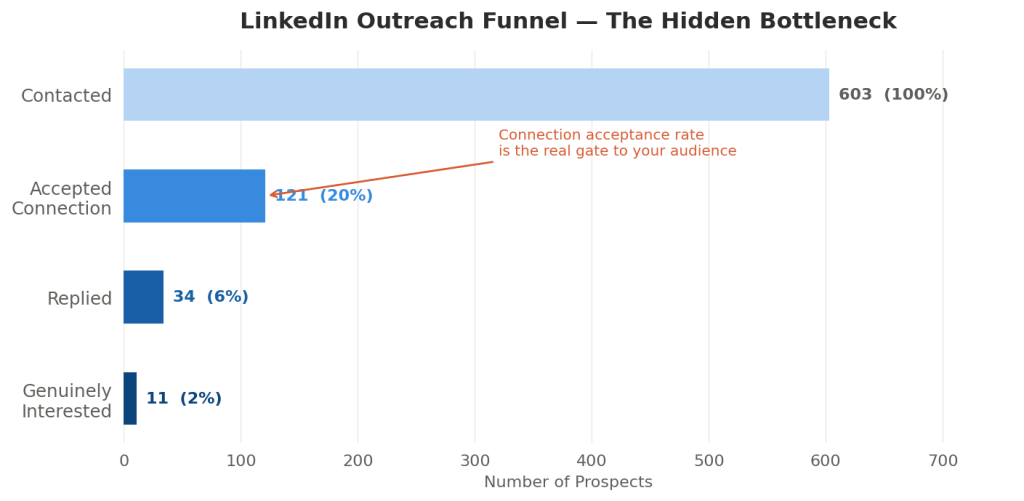
In the same campaign referenced above, 603 LinkedIn profiles were contacted. From 121 accepted connection requests, 34 replies came back — with 11 flagged as genuinely interested. That’s a positive response rate nearly three times higher than the email channel, from a smaller contacted pool.
The reason is straightforward: LinkedIn is a professional network. People expect peer-to-peer conversation there. A well-crafted connection message feels less intrusive than an unsolicited email in a work inbox.
The Hidden Bottleneck: Connection Request Acceptance
One metric most teams fail to factor into their LinkedIn planning is the connection request acceptance rate. It’s the hidden throttle on your entire LinkedIn outreach funnel.
If you send 600 connection requests and only 120 are accepted — a 20% acceptance rate — your actual reachable audience is already down to 20% of your target list before a single message has been read. This has real implications for campaign planning:
- Your effective LinkedIn volume is much smaller than it looks
- Acceptance rates vary by ICP — senior enterprise buyers accept less frequently than startup operators
- Profile quality matters enormously — a sparse or generic-looking profile tanks acceptance rates
Before you invest heavily in LinkedIn outreach, audit your profile. Clear positioning, a professional photo, an active post history, and a headline that communicates value (not just a job title) can meaningfully lift your acceptance rate. Going from 15% to 30% acceptance effectively doubles your reachable audience without touching anything else in your campaign.
Why Multi-Channel Outbound Outperforms Either Channel Alone
Here’s the insight that changes how most teams think about this: the LinkedIn vs. cold email question is a false choice. The real question is how to use both together.
Combining cold email and LinkedIn outreach in a coordinated sequence generates significantly more replies than either channel used in isolation. Estimates from practitioners suggest a 30–40% lift in total reply rates when both channels are properly sequenced — and the logic is simple.
Multiple touchpoints across different channels increase familiarity. A prospect who ignored your email may respond to a LinkedIn message two days later. Someone who declined your connection request may open your follow-up email because the name now rings a bell.
A Practical Sequencing Framework
A well-structured multi-channel sequence might look like this:
- Day 1 — Send initial cold email (short, specific, value-led)
- Day 3 — Send LinkedIn connection request (no note, or a brief, non-salesy note)
- Day 5 — Follow-up email if no reply (reference a relevant trigger or insight)
- Day 7 — LinkedIn message to accepted connections (conversational, no pitch)
- Day 10 — Final email with a soft close
The key principle here is coordination, not repetition. Each touchpoint should feel like a natural continuation of a conversation, not the same message delivered in a different format.
When to Prioritise LinkedIn vs. Cold Email
Neither channel is universally better. The right emphasis depends on your specific situation.
Prioritise LinkedIn when:
- Your ICP includes senior decision-makers (VP level and above) who have strong LinkedIn presence
- Your sales cycle is relationship-driven and requires trust before a meeting
- You’re entering a niche market where personalised, peer-to-peer outreach matters more than volume
- Your deal size is high enough that lower volume with higher conversion makes economic sense
Prioritise cold email when:
- You need to contact a large number of prospects quickly
- Your ICP is in industries where email is the dominant business communication tool
- You’re running a campaign with tight timelines and need to generate replies fast
- Your connection request acceptance rates are consistently low for a particular audience
Use both when:
- You have a well-defined ICP and reliable prospect data
- Your average deal value justifies the effort of a multi-touch sequence
- You’re targeting a market where decision-makers are active on both channels (most B2B verticals)
The honest reality is that most B2B outbound programs should be running both channels in sequence as a default, with the weighting adjusted based on what the data shows for each specific audience.
FAQ
LinkedIn often generates higher response rates than cold email, particularly when targeting mid-to-senior decision-makers. However, LinkedIn has tighter volume constraints and a hidden bottleneck in connection request acceptance rates. The best approach is to use both channels together in a coordinated sequence rather than relying on either alone.
In well-run B2B cold email campaigns with strong targeting and deliverability, a reply rate of 2–5% is generally considered solid. Positive reply rates (genuine interest, not just out-of-office or rejections) tend to sit between 0.5–2% depending on the ICP, offer, and message quality.
Low acceptance rates are usually caused by three things: a weak or incomplete LinkedIn profile, targeting prospects who are too senior or inactive on the platform, or sending connection requests with overly salesy notes. Improving your profile presentation and removing notes from connection requests often improves acceptance rates meaningfully.
The most effective approach is a staggered sequence that alternates between channels over 7–10 days. Start with email, follow up with a LinkedIn connection request, then continue with touchpoints on whichever channel the prospect engages with first. Avoid sending the same message on both channels — each touchpoint should add something new.
Research consistently shows that the majority of replies come after the third or fourth touchpoint, not the first. Most prospects don’t reply to the first message — not because they’re uninterested, but because timing and attention are hard to align. A structured sequence of 4–6 touchpoints across multiple channels significantly improves your chances of a response.
Conclusion
LinkedIn and cold email aren’t competitors — they’re complementary tools that work best when coordinated. LinkedIn wins on engagement quality, especially with senior buyers. Cold email wins on scale and speed. But the real performance gains come from building multi-channel outbound sequences that use both intelligently.
The teams generating consistent pipeline aren’t choosing one channel over the other. They’re engineering sequences where each touchpoint builds on the last — and they’re tracking the metrics (including connection acceptance rates) that most teams ignore.
If your outbound results have plateaued, the answer usually isn’t more volume on a single channel. It’s smarter orchestration across both. If that’s a system you want built for you — rather than figuring it out yourself — that’s exactly what a managed outbound function delivers.