

If you’ve run outbound for any length of time, this pattern probably feels familiar.
You set up a new sending domain, warm it up properly, launch a campaign and it works. Replies come in. Meetings get booked. Then, a few weeks later, opens drop, emails start landing in spam, and deliverability quietly collapses. The fix? Buy a new domain and start over.
For many teams, this has become “just how outbound works.”
But it’s not normal, and it’s not inevitable.
What you’re experiencing is the Domain Burnout Cycle: a repeating loop where domains lose trust because the underlying sending behavior never changes. New domains don’t fix the problem; they simply reset the clock.
What Domain Burnout Actually Is
Domain burnout isn’t the result of a single “bad” campaign or one-time mistake. Instead, it is the slow, silent erosion of your sender trust caused by a buildup of negative signals over time.
Think of your domain reputation like a credit score: it takes months to build and only a few weeks of poor habits to destroy.
The Anatomy of a Declining Reputation
Every time you hit “send,” inbox providers (Google, Microsoft, etc.) track how recipients react. Trust declines when your metrics skew toward these negative signals:
- High Deletion Rates: Recipients deleting your email without opening it.
- Low “Marked as Spam” Tolerance: Even a 0.1% complaint rate can be fatal.
- Total Inactivity: Thousands of sends with zero replies signal “noise,” not value.
- “Delete without Read”: A silent killer that tells filters your content is irrelevant.
Why Burnout Is So Confusing
Many teams experience “The Warm-up Trap.” They perform a proper 14-day warm-up, follow basic checklists, and still see their deliverability tank three weeks later.
The Reality: Warm-up only establishes initial trust. Burnout happens after the warm-up phase, when your volume, cadence, or list quality outpaces your actual human engagement.
The “New Domain” Delusion
When a domain burns, the common reflex is to buy a new one. While a fresh domain provides a temporary “clean slate,” it is not a cure. If you port the same aggressive sending patterns over to a new domain, inbox providers will identify the behavior even faster. Trust degrades in a downward spiral—each new domain burning quicker than the last.
It’s a Behavioral Failure, Not a Technical One
Domain burnout isn’t a glitch in the system; it’s the system working exactly as intended to protect users. Until the sending behavior changes, no amount of technical “hacks” or new domains will break the cycle.

The Domain Burnout Cycle (Step by Step)
The domain burnout cycle doesn’t start with bad intentions. It starts with optimism—which is exactly why it is so easy to repeat. Here is the step-by-step breakdown of how a “safe” domain becomes toxic.
Phase 1: The Honeymoon (Warm-up)
You register a new domain and follow the rules. You use a warm-up tool, sending volumes remain low, and engagement looks healthy. Because you are landing in the primary inbox, your domain feels “safe.”
Phase 2: Early Success & Validation
The outbound motion works. Replies come in, meetings are booked, and your confidence rises. At this stage, the strategy appears validated, and the pressure builds to “pour gas on the fire.”
Phase 3: Aggressive Scaling
To hit higher targets, you scale. Volumes jump from 50 to 200 emails per day. More sequences are added, and the system becomes highly efficient—but also more uniform and intense. This is where risk quietly enters the equation.
Phase 4: The Engagement Drop
Opens begin to flatten and replies slow down. Most teams mistake this for a “copy issue” or “bad targeting.” In reality, it is a reputation issue forming beneath the surface as inbox providers begin to grow suspicious of your volume.
Phase 5: The “Cliff” (Spam Placement)
Negative signals (deletes, ignored emails) compound. Emails that once landed in the primary inbox now slide into “Promotions” or “Spam.” Performance falls off a cliff, often without a single warning notification from your tools.
Phase 6: Panic Fixes & The Reset
In a scramble to fix the numbers, teams rewrite copy, swap tools, or change tracking domains. Eventually, they conclude the domain is “burned” and replace it entirely.
- The Result: The cycle resets. A new domain is warmed, early success returns, and the behavior repeats until the new domain burns even faster than the last.
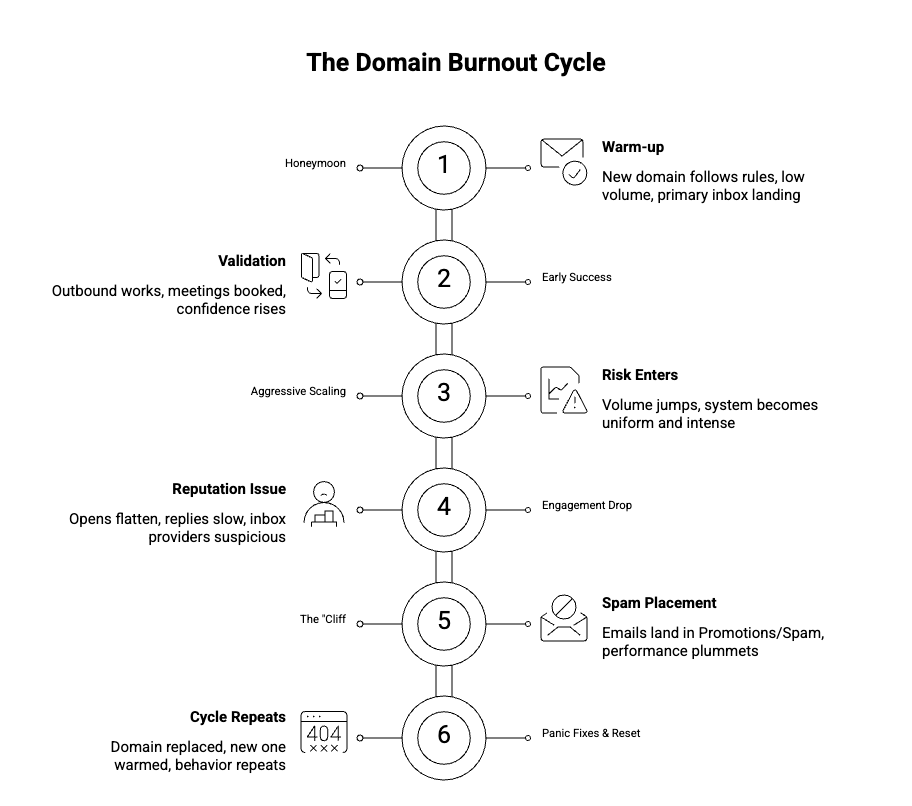
The Lesson: Breaking the cycle requires changing the input, not just the domain. If your scaling strategy is “more volume per inbox,” you are architecting your own failure.
Why Replacing Domains Doesn’t Actually Fix the Problem
Replacing a burned domain feels like hitting a “reset” button – but in reality, it’s usually just a delay. If you change the domain without changing the behavior, you aren’t solving the problem; you’re just moving it to a new address.
The Myth of the “Clean Slate”
When the same aggressive sending patterns are applied to a new domain, the outcome is inevitable. You ramp volume too fast, engagement drops, and trust erodes. The domain was never the root cause; the sending pattern was.
Inbox providers don’t judge emails in isolation. They evaluate long-term behavioral signals:
- The Velocity of Scale: How quickly you go from 0 to 100.
- Recipient Sentiment: How consistently users ignore or delete your mail.
- The “Rhythm” of Sending: How mechanical and predictable your outbound looks.
Behavioral Fingerprinting: You Aren’t Invisible
Many teams believe that a new domain makes them a “stranger” to Google or Microsoft. In reality, inbox providers connect signals across your entire infrastructure. Even if you swap the domain name, they can still identify you through:
- Shared IP Addresses: The reputation of your sending server.
- Authentication Setups: Similarities in your SPF, DKIM, and DMARC records.
- Tracking Domains: Using the same custom tracking links across multiple domains.
- Message DNA: Identical structural sameness in HTML, link placement, and subject line length.
The Downward Spiral of Domain Rotation
This is why “domain rotation” often accelerates risk instead of reducing it. Each new domain burns faster than the last because you are building reputation on top of a flawed system. What starts as a “workaround” quickly becomes technical debt that kills your ROI.
The Hard Truth: Replacing domains should be a last resort, not a core strategy. The real fix isn’t hiding from inbox providers—it’s earning and maintaining trust through Smart Throttling and human-centric behavior.
How to Escape the Domain Burnout Cycle
Escaping domain burnout doesn’t require more domains—it requires a fundamental shift in your outbound philosophy. Here are the three shifts necessary to build a resilient, long-term sending engine.
Shift 1: Treat Domains as Long-Term Assets
Stop viewing domains as disposable tools. A healthy outbound domain should be an asset that lasts for years, not weeks.
- The Goal: Protect your domain so that your reputation compounds over time.
- The Result: As your “sender age” increases alongside positive engagement, inbox providers become more lenient, not more suspicious.
Shift 2: Scale Horizontally, Not Vertically
The biggest mistake in outbound is trying to extract more “efficiency” from a single inbox. Sustainable teams expand capacity by spreading the load.
- Vertical Scaling (Dangerous): Pushing 200 emails/day through one inbox. This creates a massive target for spam filters.
- Horizontal Scaling (Safe): Spreading those 200 emails across 10 inboxes (20 emails each). This mimics natural human behavior and keeps per-inbox pressure well below the “danger zone.”
Shift 3: Move to Engagement-Led Outbound
Volume should never be your primary growth lever—engagement is. In a healthy system, your sending volume is tethered to your reply rate.
- The Feedback Loop: If your reply rates are high, you have “earned” the right to increase volume. If engagement drops, your system should automatically throttle back to protect the domain.
- The Benefit: This creates a resilient system that self-corrects before a “cliff” is ever reached.
The Result: From Friction to Momentum
When these principles replace the “send more” mentality, your outbound stops being a game of cat-and-mouse with Google and Microsoft. Instead of constantly resetting your progress with new domains, you start building predictable momentum.
Final Thought: Smart throttling and human-centric scaling don’t just protect your domains—they protect your revenue. A system that stays in the Primary Inbox will always outperform a high-volume system that lands in Spam.